Showing posts with label electric heating elements. Show all posts

How ISO 9001 Protects BCE’s Leadership in Electric Heaters and Vacuum Feedthroughs

ISO 9001

Belilove Company-Engineers (BCE) in Hayward, California, has built its reputation on precision manufacturing, engineering depth, and the ability to solve complex thermal and vacuum-related challenges. As a long-standing producer of electric heating elements and vacuum feedthroughs, BCE occupies a place in industrial supply chains where reliability, consistency, and documented process control are not just helpful—they are essential. In 2025 and for the foreseeable future, maintaining ISO 9001:2015 certification remains one of the most important strategic decisions the company can make. 

Although the manufacturing world is evolving rapidly through automation, digital quality systems, and advanced analytics, ISO 9001 remains the universally recognized foundation for quality management. For a company like BCE, whose customers depend on stable, traceable, and repeatable performance, ISO certification strengthens trust at a time when supply-chain expectations are higher than ever.
ISO 9001:2015 still acts as a global signal that a manufacturer operates with discipline and accountability. Many OEMs will not even consider a supplier unless that certification is in place. 

Because BCE supports industries that require high reliability—from semiconductor tools and analytical equipment to aerospace, medical, research, and industrial heating systems—its ISO certification remains a powerful indicator of competence. Customers evaluating heating elements or vacuum feedthroughs want assurance that temperature uniformity, material purity, electrical integrity, and hermetic seals are backed by documented processes rather than informal know-how. ISO 9001 ensures that BCE’s work is systematized, audited, traceable, and continuously improving. Even as quality tools evolve, this formal validation of process control continues to influence purchasing decisions across technical and regulated markets.

In practical terms, ISO 9001 provides BCE with a structural advantage that goes far beyond paperwork. It reinforces a culture in which calibration, machining accuracy, weld integrity, inspection methods, and supplier management are carefully monitored and reviewed for improvement. This matters tremendously in the world of electric heaters, where design tolerances and watt-density calculations must be exact to achieve stable, safe thermal performance. It is equally vital in vacuum feedthrough manufacturing, where every brazed joint, insulator, conductor, and sealing surface must perform flawlessly in environments that may involve extreme temperatures, high voltages, or deep vacuum. ISO 9001 amplifies BCE’s engineering expertise by ensuring that every step of production is executed within a disciplined system that reduces variation and improves long-term reliability.

Looking ahead, BCE’s ISO certification will become even more valuable as digital quality tools continue to reshape manufacturing. Customers are increasingly evaluating suppliers not only on the final product but on the integrity of their entire data trail. They want to know how non-conformances are analyzed, how corrective actions are documented, how supply chain risk is managed, and how process improvements are implemented over time. ISO 9001 has already begun shifting toward these data-driven expectations, and future revisions will likely place even greater emphasis on traceability, risk management, and real-time process feedback. BCE’s decision to maintain certification positions the company to integrate seamlessly into these next-generation quality ecosystems. It signals that BCE is prepared not only to meet today's specifications but also to adapt to emerging customer requirements and industry standards as they evolve.

While some lower-complexity manufacturing sectors are seeing customers relax ISO requirements, the opposite is happening in the specialized markets BCE serves. As electric heaters and vacuum components become more customized and application-specific, manufacturers must demonstrate increasing levels of quality control. That expectation is amplified by the broader shift toward automation, electrification, and miniaturization across industry. Companies building advanced scientific instruments, semiconductor equipment, medical devices, and energy systems cannot afford component failures. They also cannot afford suppliers who lack documented systems that ensure consistent output. BCE’s ISO certification is therefore a critical part of its value proposition because it protects customers from risk at a time when supply chains are under constant scrutiny.

Maintaining ISO 9001:2015 is not just about compliance or checking a box. For Belilove Company-Engineers, it is a commitment to excellence that aligns directly with the expectations of the industries they support. It reinforces the integrity of their engineering work, the consistency of their manufacturing processes, and the reliability of the components they deliver. As the manufacturing landscape shifts toward digital oversight and increasingly stringent customer requirements, BCE’s ISO certification will remain a differentiator and a cornerstone of trust. It preserves BCE’s competitive strength today and positions the company to thrive in the demanding, innovation-driven markets of tomorrow.
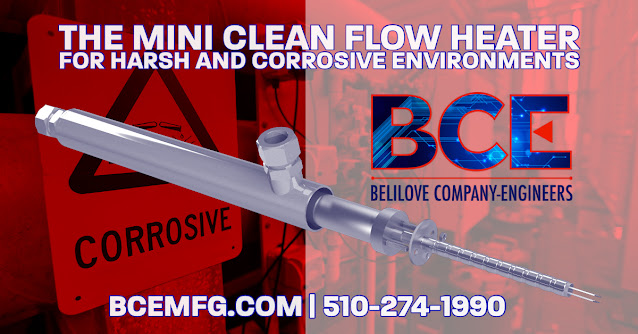
Mini Clean Flow Heater for Harsh Environments

Mini Clean Flow Heater for Harsh Environments

BACKGROUND

The BCE application was a custom heating solution for harsh environments where the medium material needed to be heated using low carbon metals.  Stainless steels such as 316L and 304L are the best option for low carbon, these materials were not readily available on the a standard Mini Clean Flow (MCF) heater.  BCE adapted making all wetted parts 316L or 304L while being heated with a 321 stainless steel heat source.   

SCOPE

The Mini Clean Flow Heater - Harsh Environment needed to satisfy the following:
  • Temperature outlet needed to be 100⁰C  
  • Perpendicular configuration, with locking fittings
  • Body must pass Helium Leak rate of 1 x 10⁻⁷ cc/sec He 
  • Pressure test of 50PSI 
  • Ability to place heater in a series flow configuration if necessary
  • Thermocouple for additional temperature measurement
  • 400 Watt, 120 Volt
  • All wetted surfaces must be 304 or 316 Stainless Steel L (low carbon) 
OUTCOME

This BCE MCF heater was tested to 100⁰C with the mass of the heater being slightly above 5 lbs.  The 100⁰C temperature was reached within about 2 minutes.  This efficiency was achieved by maintaining good contact with the internal heat source and the low carbon steel MCF heater body.  


BCE

+1 510-274-1990 

Experienced Electric Heating Element Designers Speed Development Time and Save Money in OEM Product Development

Electric Heating Element Designers

The application of localized electric heating elements is one area that OEM design engineers find themselves navigating in unchartered waters. Very logically, they often attempt to use an off-the-shelf cartridge, silicone rubber, or mica heaters for their specialized heating requirement. Unfortunately, this approach compromises layout, packaging, and performance. A better alternative is considering a custom heating element developed in consultation with an experienced custom heater manufacturer.


Technology advances rapidly, and findings in material science, medicine, pharmacology, biology, and semiconductors occur daily. These advancements in technology open the door for performance improvements leading to new treatments, medications, materials, and processes. Original equipment manufacturers (OEM's) of analytical, semiconductor, biomedical, life-science, and aerospace equipment continually design new equipment to apply and leverage these new discoveries. 


Experienced custom electric heater designers provide many essential benefits throughout the product development cycle. For instance:

  • Front-end, practical design review to optimize manufacturability.
  • Timely prototype development.
  • Strong alliances with vendors.
  • Single source responsibility.
  • Testing, calibration, and QC.
  • Inventory management.
  • Value-added assembly.

The heater manufacturer partner provides:


  • Critical guidance in material selection.
  • Power requirements under load.
  • Temperature vs. time data.
  • Watt density optimization.
  • Packaging advice.


Their help provides high performance, precise fit, and extended heater life.


The pressure to produce new devices that offer greater efficiencies, compactness, and production is always present. Each item in the precedent design undergoes scrutiny and transitions to a contemporary fit, form, or function. New components are needed to meet the new design requirements. By choosing an experienced custom electric heating element design partner, the OEM gets the precision they need, plus scores of other benefits derived from the heater vendor's tacit knowledge and past experiences.


BCE

+1 510-274-1990

HK 300mm Compressed Heater Chuck

HK 300mm Compressed Heater Chuck

 BACKGROUND

To reduce the overall cost for an existing application, BCE developed a 300mm aluminum heater chuck that is un-brazed utilizing the compression of two plates with countersink set screws. The heater surface specs were 0.003” flatness at a 0.005” parallelism. Using a 208-volt power supply at 9.7ohm, start @ 25°C temperature and ramped from 100°C to 465°C in 23 minutes. 

SCOPE

Aluminum Heater Chuck needed to satisfy the following:

  • Achieve temperature up to 435°C  @ +/- 2% or better 
  • Internal element must be able to withstand temperatures up to 600°C
  • Anodized surface for electrical isolation 
  • 208 Volt, 9.7 Ohm, 4,460 Watt (+5% / - 10%) 
  • Thermocouple bore hole to be placed at the center (variable) 
  • 4 point temperature profile on the top surface of the heater 
  • Used an infrared sensor for each 4 point locations
  • FINISH: Hard coat anodize per MIL-A-8625F, Type 3 Class1 Hard-coat thickness  

OUTCOME

BCE produced a highly effective high 300mm heater with exceptional uniformity better than the proposed 435°C (+/-2%).  After the initial ramp, the heater maintained 435°C (+/- 1%) as per the chart below (Temp profile #5). 

300mm heater chuck
BCE
510-274-1990

Industrial and OEM Electric Heating Elements

Electric Heating Elements
Electric heating elements are used to provide localized heat for people, animals, and equipment. Because electricity is widely available, it's a logical source of energy for the creation of heat. Electricity is converted to heat by the resistance to electrical current flow by a conductor. This process is known as Joule heating or Ohmic heating. The transfer of heat from heating element to the workpiece needing to be heated is done through conduction, convection, or radiation. Electric heat is simple, clean, and efficient. Unlike other forms of energy to create heat, such as fossil fuel or nuclear sources, there are no concerns with flammable fuels, radioactive materials, or harmful by-products.

There are many places where electric heaters comes in touch with our lives each day. They are used to keep living spaces warm for human beings and animals (commonly referred to as "comfort heating"). Electric heating elements are found in common home appliances such as toasters, stoves, and hair dryers. But beyond the day-to-day consumer applications, electric heaters are also ubiquitous in industry. Industrial heating elements are critically important to many manufacturing processes, wether as an equipment component (OEM heaters), or directly used in the the processing of raw materials (industrial electric heaters).

In industry, electric heating elements are commonly used in the manufacture of electronics, semiconductors, medical devices, food equipment, plastics equipment, pharmaceuticals, glass, ceramics, primary metals, aerospace equipment, and HVAC equipment.   While the industries that use electric heaters vary widely, the application of electric heaters narrows to the heating of flowing fluids (which include gases and air) or the heating of a solid metallic, or non-metallic, workpiece.

Types of Electric Heaters Used in Industry and Original Equipment Manufacturing


While the modes of transferring heat from on body to another will always be conduction, convection, or radiation, the mechanical and physical properties of industrial heaters change dramatically, depending on the media being heated, the physical and limitations of the application, and the application's temperature requirements. The following are the most common types of industrial and OEM heating elements used.

Tubular Heating Elements

Tubular elements are a common form of electric heater. Essentially a metal tube with resistance wire and electrical insulation inside, tubular elements can be configured into almost uncountable shapes and sizes.

Cartridge Heating Elements

Cartridge heaters provide localized heat to restricted work areas requiring close thermal control. Dies, platens and a variety of other types of processing equipment are efficiently heated.

Flexible Heating Elements

Flexible Heaters are made from a variety of materials such as Silicone rubber, Kapton, Mylar, or Neoprene and have etched foil or wirewound resistance elements. Fast responding with excellent heating profiles, these heaters solve many tough equipment heating challenges. Custom shapes and terminations are designed to suit. Rapid prototype service available.


Ceramic Heating Elements

Composed of high temperature materials such as alumina ceramic substrates. The metal heating resistance element is thickfilm technology or wire.

Thick Film Heating Elements

A process of depositing a resistor “trace” of tungsten paste on top of a ceramic part in a process very similar to screen printing. The deposition process allows for close control of thickness and width of the resistor, thus accurately controlling the conductor resistance, wattage, watt density, and uniformity of the heated part.

Mini Clean Flow - Stream Heater

Mini Clean Flow Heater
A biotechnology company approached BCE in need of a custom heating solution. Their application required that the media must be heated to 75 °C in order to eliminate any pathogenic bacteria that may be present. Their current system was not heating the medium efficiently requiring a high watt density solution causing heater failure and carbonization of the material.

SCOPE

The Mini Clean Flow - Stream heater needed to satisfy the following:
  • Outlet of temperature of 75 °C (± 2 °C) to eliminate bacteria
  • Ability to place heater in a series flow configuration if necessary
  • Built in thermocouple for accurate temperature measurement
  • 185 Watt, 120 Volt
  • All wetted surfaces must be 304 Stainless Steel
  • Watt density below 30 WSI to avoid damage to the fluid or system
OUTCOME

Test Results
Test Results - Click for larger view.
BCE designed a double wall inline heater with exceptional heat uniformity and reduced heat losses. The Mini Clean Flow Stream heater was built with internal components designed to turbulate the medium to increase efficiency and minimize watt density. This compact, low mass heater had the ability to precisely control the inner temperature for either over-temp or process medium control. The Mini Clean Flow – Stream was the ultimate solution for this application resulting in a more efficient process to eliminate pathogenic material.

For more information, contact BCE by calling 510-274-1990 or visit their web site at https://bcemfg.com.

Important Safety and Performance Precautions When Using Electric Heating Elements

Important Safety and Performance for  Electric Heating ElementsThe safety and performance of electric heating elements is dependent upon the user's proper handling, installation, control, application, and maintenance. While it is impossible to anticipate all the operating conditions for electric heaters, the following items are universal precautions that must be considered in every situation.

Electric heater element handling, installation, application, and maintenance precautions:
  1. Always have a qualified person install the heating element in accordance with the National Electrical Code and/or local codes.
  2. Always use extension wire rated for the current, voltage, and exposure temperatures suitable for the application.
  3. Always use the proper environmentally rated electrical connection and housing for the type of  service the heater will see.
  4. Use temperature controlling and/or limiting devices with electric heaters.
  5. Use ground fault protection where required.
  6. Do not apply higher voltages than the marking on the heater indicates.
  7. Do not operate heaters in thermally insulated conditions where sheath temperatures may exceed the recommended maximum.
  8. Do not expose heaters to conditions, substances or contaminants that can damage, change, or destroy the integrity of the heater's sheath or electrical insulation.
  9. Heaters by their nature can absorb moisture which can cause high leakage current. A megohm test to the manufacturers specification should be performed to ensure moisture levels are within acceptable standards.
  10. Do not apply heaters with operating sheath temperatures that exceed the safe exposure temperature of the process media.

Cartridge Heater Design

All cartridge heaters are not created equal. Some are designed to provide reasonable performance at a reasonable cost. Some cartridge heaters are designed for high performance and long life, but come at higher cost. Neither design is superior or inferior when applied properly. Both designs have their place in the world.

First, it's important to understand a very basic concept when applying electric heating elements. All electric heating elements need to move the heat away from the resistance wire into the surrounding media. This is done through conduction, convection, and radiation. Preventing resistance wires from getting too hot is the goal.

The difference comes down to internal design. 

Low watt density cartridge heater
Low watt density cartridge heater.
From the outside, all cartridge heaters may look the same, but internally they're worlds apart. Lower watt density (lower cost) heaters use a helically wound resistance wire threaded through holes a ceramic bobbin. The nichrome resistance wire and bobbin are then inserted in a metal tube with loose magnesium oxide (MgO) back-filled around the bobbin. The result is a cartridge heater designed for lower operating temperatures and lower watt densities. These limitations are caused the insulating affect of the air surrounding the magnesium oxide grains and placement of the helically wound wire. Loose magnesium oxide provides poor thermal conduction and therefore prevents the resistance wire from conducting it's heat outward. The inability for the wire to shed heat is further complicated by the placement, in relationship to the sheath, of the resistance wire.
High watt density cartridge heater
High watt density cartridge heater.

High watt density cartridge heaters, capable of higher operating temperatures and long life include a different internal design, incorporating a swaging process and great care to resistance wire placement. High watt density heaters have very precisely wound nichrome resistance wire around the ceramic bobbin, and then, with exact centering and very tight tolerances, vibrate MgO into the metal tube surrounding the bobbin/wire core. Once the MgO is added, the heater goes through a swaging process that reduces the inner diameter of the metal tube. The result is compacted magnesium oxide with rock-like properties and much better thermal conduction from resistance wire to external heater sheath.

Both styles of cartridge heaters have their value and proper application. Using low watt density cartridge heaters on a simple applications like glue pots is fine, and will yield good life and performance. On the other hand, high temperature applications such as plastic injection mold machines require the higher performance and extended life that only a swaged heater will provide.

Contact BCE for more information on electric heating elements. Visit https://www.belilove.com or call (510) 274-1990.

Rapid Response Electric Heaters Designed for Clean Gases and Liquids

Mini Clean Flow Heater
In advanced technologies such as analytical, biomedical, pharmaceutical, aerospace, electronics and laboratory applications, special purpose electric heating elements are required for heating high purity fluids and gases. These applications require rugged design, fast heat-up, tight control, high temperatures and the ability to withstand exposure to harsh solvents and corrosive gases. They also must be constructed in a way to prevent contamination of the process media.

The use of standard screw plug immersions heaters, screwed into a stainless steel welded vessels (known as circulation heaters) are almost always a misapplication for these unique requirements. Circulation heaters create more problems due to leaks, material compatibility, poor controllability, and bulky size.

BCE, a northern Californian manufacturer of custom heating elements offers it's Mini Clean Flow Heater specifically for these applications. These heaters are designed for heating "clean" liquids and gases normally found in fuel cell, bio-med, laboratory, food, semiconductor and pharmaceutical applications.

The Mini Clean Flow Heater operates in a liquid or gas stream providing very fast response times and accurate control capability.

The heating elements in the Mini Clean Flow Heater are isolated electrically from the process media, protecting them from contaminants and providing long life.

Summary:
  • Designed for heating of clean gases or liquids
  • Gas flow passes over an enclosed heated body; not exposed to resistive elements (Nichrome)
  • All parts exposed to gas flow are constructed of 304 stainless (other material available)
  • High temperatures
  • Custom wattages, voltages, inlet and outlet fittings (NPT, SAE, BSP &VCR) are available.
  • Made in U.S.A.

For more information, visit http://heater.belilove.com

Why Cartridge Heaters Fail

By understanding the most common reasons cartridge heaters fail, users can take preventative steps in their applications to achieve optimum heater life and lower equipment ownership costs.

Improper Fit
The most common cause of cartridge heater failure is an improper fit in the hole into which it is inserted. If the heater cannot dissipate the heat being generated and produced by contact with the sheath, the temperature inside the heater will continue to rise until the heater fails.

Moisture and/or Impurities
The MGO used in cartridge heaters is hydroscopic. Every time power to electric heaters is eliminated, an internal vacuum occurs which draws in air from the surrounding area. If moisture or impurities (oil, gas, etc.) are present, they can be drawn in to the heater, and cause a short circuit resulting in a heater failure.

Watt Density is Too High
If the watts/square inch is excessive, the heater will not be able to dissipate the heat and the heater will fail.

Incorrect Voltage Applied
The wattage of any electric heater varies as the square of the voltage. If a 120 Volt heater is powered on 240 Volts, the wattage will be 4 times greater than that for the same 120 Volt heater. Under normal conditions, this may result in heater failure.

Frequent Temperature Cycling
Rapid cycling of heaters from very low to very high temperatures shortens their life considerably.


About BCE
BCE is a recognized leader in manufacturing and applying resistance heating elements in many industries, including medical, analytical, packaging, process, food equipment, and aerospace. BCE's extensive standard and custom product lines include:
  • Cartridge heaters
  • Immersion heaters - ideally suited for heating various liquids
  • Air process heaters - for providing hot air and gas up to 1,400 degrees
  • Stainless steel strip and thin strip heaters in various sizes
  • Self-contained one-piece assembly coil and rope heaters
  • Tubular and finned tubular heaters - specially built to resist impact, vibration corrosion and temperature extremes
  • Band heaters for a multitude of applications
  • Ceramic and crankcase heaters
For more information, visit http://heater.belilove.com or call (510) 274-1990.

Heaters for Process Air and Gases

electric heaters for process air or gas streams
Examples of process air heaters
Courtesy Hotwatt
Many process applications require heating of an air or gas stream. There is a wide variety of electric heating units specifically designed for processing flowing streams of air or non-flammable gas.

The primay selection criteria for a process air heating unit should be the heating capacity or wattage. Determine the maximum flow rate, inlet and outlet temperatures, then apply a simple formula from the document included below to find the minimum watt rating for a heating unit. Outlet temperatures can range to 1000°F (540°C) and flow rates to 200 scfm. Custom units can accommodate applications beyond those limits.

The outlet temperature can be controlled in a number of ways. One is to regulate the power applied to the heater. This would be applicable to a process that required a constant or minimum air flow rate. If the flow rate can be varied, another method of temperature control is available. Maintaining constant power to the heater and varying the air flow rate can serve as a means of controlling the output temperature.

Various connection sizes and fittings can be included in the heater assembly design to accommodate its incorporation into a process equipment train. Share your process heating requirements and challenges with experienced application engineers, combining your own process knowledge with their product application expertise to develop effective solutions.


Flanged and Screw Plug Electric Heating Assemblies for Industrial Applications

flanged tubular electric heater assembly
Flanged Tubular Electric Heater Assembly
Hotwatt
Electric heating, though not the most energy efficient means of delivering heat, provides some distinct advantages as a means of controlling the temperature or thermal component of fluids and solids throughout commercial and industrial settings.

Tubular elements are a common form of electric heater. Essentially a metal tube with resistance wire and electrical insulation inside, tubular elements can be configured into almost uncountable shapes and sizes. Manufacturers typically offer a range of standard sizes and ratings, but that should never deter you from making contact to discuss your ideas for a custom arrangement.

Two mounting schemes that are readily used on tanks or other vessels are the screw plug and flanged heater assemblies. In each case, tubular heaters are bent in a "U" shape and fitted into either a pipe flange or a threaded plug. A junction box encloses the electrical terminations for the heating elements, providing a single ended assembly that can be easily mounted to an industrial standard mechanical connection. These assemblies are useful for tank or vessel OEMs that wish to provide a fluid heating option to their customers.
tubular electric heaters screw plug mounting
Examples of Screw Plug Electric Heaters
Hotwatt

Electric heat enables a properly configured controller to proportion heat into a subject fluid across a wide range, from very small packets that could be fractional percentages of full capacity to the fully available output of the heater. The units are compact, rugged, and can be configured to accommodate a broad array of industrial environments and applications.

Selecting or specifying a unit is uncomplicated. Determine the amount of heating capacity needed, then select the assembly mounting type (flange, screw plug, or other). Select an element sheath material that is compatible with the process media and a termination enclosure that suits the surrounding environment. Application assistance is available from product specialists who are well versed in the available options and can help you specify an assembly that provides excellent performance and an extended service life.

Hotwatt Electric Heating Elements for OEM, Laboratory, and Industrial Applications

Hotwatt
Hotwatt Electric Heating Elements
Hotwatt is a leader in manufacturing resistance heating elements. They have an extensive product line that includes cartridge heaters, immersion heaters ideally suited for heating various liquids, air process heaters for providing hot air and gas up to fourteen hundred degrees, stainless steel strip and finned strip heaters in various sizes, self-contained one piece assembly oil in rope heaters; tubular and finned tubular heaters which have been specially built to resist impact, vibration, corrosion, and temperature extremes; extremely versatile band heaters for a multitude of applications; and ceramic and crankcase heaters for custom solutions. Hotwatt's technical information and accessory items ensure that hard what has everything you need for complete thermal system.

Contact BCE for more information at (510) 274-1990 or visit http://www.belilove.com.

Electric Heaters 101: Get the Heat Out of the Heater

cartridge heater
Internal view of swaged cartridge heater.
Metal-clad electric heating elements share one very common and very important requirement for optimal performance - get the heat away from the resistance wire and into the work as efficiently as possible.

At the heart of most resistance type electric heaters is a nichrome alloy wire, or ribbon, referred to as the heating "element". It acts as a resistor to the electrical current and gives off heat. With sheathed heaters, the heating element is then wrapped in some sort of electric insulating material such as mica or magnesium oxide (MgO), and then encased in a metallic sheath. Unfortunately, both the electric insulator and the metallic sheath act as heat insulators to some degree, which cause the nichrome wire to get very hot. Nichrome wire has a melting point of 1400 deg. C (about 2500 degrees F). While this sounds high, the wires and ribbons can easily exceed these temperatures in normal operation when not allowed to adequately conduct heat.

Very often electric heater failure can be directly attributed to poor conductivity between the heating element and the process medium. Whether it be a cartridge, strip, band, duct or immersion heater the principle is the same - lower resistance wire temperatures equal longer heater life.

When applying cartridge heaters, special care has to be taken to the bore tolerance of the hole where the heater is inserted. The tighter the bore tolerance, the more efficiently the high internal wire temperatures are conducted away.  Tolerances of several thousandths of an inch can change the life expectancy of a cartridge heater significantly.

Strip and band heaters require tight, full surface area clamping to maximize life and performance, while duct heaters and immersion heaters require circulation to transfer heat away from the element, and keeping resistance wire temperature within reasonable operating limits.
strip heater
Internal view of band & strip heater.

Any situation where the heater is exposed to a stagnant air gap (or stagnant fluids) will most likely result in over temperature of the wire and failure at that point.  With this in mind, anyone applying traditional resistance type, electric heating elements must be very aware of maintaining very intimate contact between the heating element and the item or process being heated.

Whenever applying electric heating elements, the consultation of an applications expert is always recommended. They will be able to consider many other operational factors such as wire watt density, conduction properties, control scheme and overall thermal system dynamics.

Ceramic Thick-Film Heaters for OEM Analytical and Medical Equipment

ceramic heating element
Ceramic heating element
Manufacturers of laboratory and process analytical equipment, as well as medical equipment, are continually challenged to make products smaller and more compact. Smaller, more efficient components are always in demand. Providing heat for sample stability or a chemical reaction is a common requirement. There's an ongoing challenge to find smaller and more efficient electric heaters.

Many traditional electrical heating elements are limited in size and efficiency due to the balance required between conductor temperatures and the the heat transfer properties of the dielectric material used in their construction. Sometimes the mass required to insulate electrically is at odds with the ability to drive the heat into the part.  Metal sheathed heaters use compacted magnesium oxide, or wafers of mica for dielectric. While these provide good electrical insulation, they also inhibit thermal transfer from resistance element to the external part. Flexible heating elements use a variety of rubbers or fluoropolymer elastomers that sandwich the resistance element. While these designs are dielectrically strong, and allow for excellent heat transfer, they are limited by the maximum operating temperatures and watt densities of the elastomer.

A newer, alternative technology is “thick-film” ceramic heaters, a process of depositing a resistor “trace” of tungsten paste on top of a ceramic part in a process very similar to screen printing. The deposition process allows for close control of thickness and width of the resistor, thus accurately controlling the conductor resistance, wattage, watt density, and uniformity of the heated part.

The use of ceramics as the heater body (referred to as a heated part), has many advantages. Ceramics are chemical inert, offer excellent thermal conductivity, impervious to moisture, and are very durable. The downside to using ceramics as heaters, however, is the difficulty in machining to very tight tolerances. In recent years though, many of the ceramic machining hurdles have been overcome through advanced ceramic machining processes.

In the early years of development thick-film ceramic heaters had a few major challenges. Dealing with mis-matched expansion coefficients between the ceramic substrate and the conductor trace was considerable. Years of research now have yielded excellent data on compatible materials making this problem much less significant. Another challenge is controlling the tolerance and repeatability of the heater resistance from part-to-part. Improvements and advancement in this area are made possible with laser etching, tighter screening procedures, and advanced machining.

The use of ceramics provided many interesting possibilities in heater design, and many materials were tested and researched. The most common ceramics used for thick-film heaters today are alumina (Al2O3), silicon nitride (Si3N4), beryllium oxide (BeO), and aluminum nitride (AlN). Each material has its own unique chemical and physical properties, but all exhibit good thermal conductivity and good dielectric properties.

The combination of excellent thermal conductivity, high dielectric, high watt densities, precise thermal profiling, and custom shapes and sizes that make thick-film ceramic heaters so attractive to equipment manufacturers. Providing more heat in smaller areas is easier than with traditional heaters. Additionally, some of the ceramics used are non-contaminating and moisture-proof, making them excellent candidates for clean and ultra-clean applications.

Ceramic thick-film heaters have many advantages over metal or elastomer sheathed heaters beyond just providing a more compact component. They are very fast acting, durable, moisture proof,  and contamination proof. They can be designed and machined to virtually any size or shape, watt density, voltage, and distributed wattage profile. While the initial design and prototyping requires investment in time and money, the resulting product can be mass produced economically and with repeatable accuracy and quality.

For more information, contact:
BCE
(510) 274-1990
www.belilove.com

Suggested Watt Densities for Electric Heating Elements

watt density in electric heaters
Always consider proper watt density
for your electric heater application.
Reprinted with permission from Hotwatt

The rates below are recommended watt densities for use with various materials. Safe values vary with operating temperature, flow velocity, and heat transfer rates. In general, the higher the material temperature, the lower the watt density should be, especially those materials which coke or carbonize, such as oils. Watt densities should be low if a material is being heated to a temperature near where the change of state to a vapor occurs (water to steam @ 212°F) since the vapor state has much poorer heat transfer capabilities.

Material being heated Maximum Operating Temp.°F Maximum Watts Per Sq. In.*
Acid Solutions:
   Acetic
   Chromic (5%)
   Citric
Ferric
   Chloride (40%)
Hydrochloric
Nitric (50%)
Sulphuric

212
Boiling
Boiling
Boiling

150
Boiling
Boiling

40
40
40
40

30
40
30
Alkali & selected oakite cleaning solution 212 40
Asphalt binder, tar, other viscous compounds 200
300
400
500
8
7
6
5
Caustic Soda 2%
                    10%
                    75%
210
210
180
45
25
25
Coffee (Direct Immersion) Boiling 90
Dowtherm A®
   flowing at
   1 ft/sec or more
   Non-flowing


750
750


22
10
Ethylene glycol 300 30
±Fuel Oils
   Grades 1 & 2 (Distillate)
   Grades 4 & 5 (Residual)
   Grade 6 & Bunker C
   (Residual)
200
200
160
22
13
8
Gasoline, kerosene 300 20
Glue (heating indirectly using water bath Lead-Stereotype pot) 600 35
on
casting
Liquid ammonia plating baths 50 25
** Lubrication Oils
   SAE 10, @ 130°F
   SAE 20, @ 130°F
   SAE 30, @ 130°F
   SAE 40, @ 210°F
   SAE 50, @ 210°F

250
250
250
250
250

22
22
22
13
13

* * Some oils contain additives that will boil or carbonize at low watt densities. Where oils of this type are encountered, a watt density test should be made to determine a satisfactory watt density.


Material being heated Maximum Operating Temp.°F Maximum Watts Per Sq. In.*
Metal melting pot 500 to 900 20-27
Mineral oil 200
400
20
16
Molasses 100 2-3
Molten salt bath 800-950 40
Molten tin 600 20
Oil draw bath 600
400
20
24
Paraffin or wax 150 16
Photographic solutions 150 70
Plating solutions:
   Cadmium plating
   Chrome plating
   Copper plating
   Nickel plating
   Tin plating
   Zinc plating

40
40
40
40
40
40
Salt Bath 900 30
Sea Water Boiling 90
Sodium cyanide 140 40
Steel tubing cast into aluminum 500 to 750 50
Steel tubing cast into iron 750 to 1000 55
Heat transfer oils
   flowing at 1 ft/sec or more
500
600
650
750
22
22
22
15
Trichloretylene 150 20
Vapor degreasing solutions 275 20
Vegetable oil (fry kettle) 400 30
Water (process) 212 60
Water (washroom) 140 80-90

* Maximum watt densities are based on heated length, and may vary depending upon concentration of some solutions. Watt density should be kept as low as possible in corrosive applications since higher watt densities accelerate corrosive attack on element sheaths. Consult BCE for limitations.

Important: The above values are estimates. It is strongly suggested that you discuss your requirement with an application expert before you apply any electric heating element in to a process where the proper watt density is unknown.

NEW BCE Clean Flow Electric Mini-Heater with Probe Assembly

Check out the new design mini heater designed to heat flowing gases and liquids. Designed and developed by BCE.

Applications

Baking, Drying, Laminating, Metal Working, Packaging, Plastic Welding, Preheating, Sealing, Soldering, Shrink Fitting, Synthetic Fabric Sewing.

Mini Clean Flow Electric Heater:
  • Designed for heating of clean gas. 
  • Gas flow passes over an enclosed heated body; 
  • not exposed to resistive elements (ni-chrome). 
  • All parts exposed to gas flow are constructed of 
  • 304 stainless (other material available). 
  • High temperatures and ranges are available ask a 
  • BCE engineer.

Ceramic Thick Film Electric Heating Elements

Need a high performance electric heater in a low mass, low profile package? Need to put high watt density a small space? Or maybe you need to distribute wattage disproportionately to an irregularly shaped part?  Thick film ceramic heater technology is the answer!
ceramic thick film heaters
Ceramic thick film heaters.

Ceramic thick film heaters are easily customized into a variety of shapes and sizes, and provide excellent heat transfer. Long life is assured by precise thermal matching between ceramics and resistor traces.

The heater ceramic substrates provide excellent hardness, wear resistance, and compression strength. The physical properties of the ceramic also provide optimal thermal conductivity and excellent uniformity. Thick film ceramic heaters are perfect for application in analytical equipment, life science equipment, mass spectroscopy, medical devices, semiconductor processing, packaging machines, and in applications ultra pure and chemically aggressive media.

Flexibility in Design:
ceramic thick film heaters
Custom shapes
and designs.
  • Virtually unlimited in shape or size.
  • Single or double sides, one or two layers per side.
  • High purity applications no problem.
  • Precise control and uniformity via custom watt densities and patterns.
  • Distributed wattage for ideal application of heat to part with minimal losses.
  • Multiple heating zone capabilities for more precise control.
  • Available in virtually any voltage, AC or DC.
  • Integrated sensors including thermistors, thermostats, thermal fuses, and printed RTD's.
  • Wide variety of lead configurations conforming to shock and vibration, vacuum and purity standards.
For more information contact:

BCE 
21060 Corsair Blvd
Hayward, CA 94545
Phone: (510) 274-1990
Fax: (510) 274-1999
www.belilove.com
E-mail: sales@belilove.com


Custom Heating Elements and Controls

custom heating element
Custom heating element.
Many types of industrial and manufacturing equipment, including analytical instrumentation, semiconductor, photovoltaic, medical, plastics processing, foodservice packaging, and aerospace equipment require some kind of custom electric heater, controller, and sensor.

For instance here, in semiconductor processing, you can find a need for electric heating in all these areas:  Bake platen heaters, bake/chill pedestal & platen heaters, hot chuck heaters, high temperature platen heaters, standard pedestal heaters, vacuum chamber heaters, and aluminum pedestal heaters.

A well engineered thermal system considers overall heat load, maintenance power requirements, control method, and sensor location. Working with a vendor who has the experience and background in this kind of product development is critical. Careful consideration of form, fit, and function requires the guidance an experienced applications engineer to avoid wasted time and money. 


Electric Heating Element Technical Reference Guide

Carnot engine diagram
(courtesy of Wikipedia)
Here’s a very handy reference document (courtesy of Hotwatt) for the application of electric heating elements in industrial and OEM applications such as extruding, vulcanizing, laminating, curing, bonding and thermoforming.

The heater application guide provides all the important technical look-up tables required to properly apply electric heaters, such as wattage calculation formulas and examples, properties of metals properties of non-metallic solids, properties of liquids and gases, suggested watt densities, estimates of wattage required, guide for heat losses, suggested sheath materials, installation,  Ohms Law, and typical wiring diagrams. The reference document is also very helpful when designing custom electric heating elements and designing a thermal system.