Showing posts with label thermal system. Show all posts

Basic Wattage Requirement Calculations for Metals, Non-metals, and Gases

Accurately heating various materials such as metals, non-metals, liquids and gases is complex. There are many variables to consider. Material properties such as density, thermal conductivity, specific heat and time all must be known to calculate a correct wattage value. Phase change (solid to liquid, liquid to gas) requires additional calculations to account for latent heat of vaporization and latent heat of fusion.

BCE, a manufacturer of custom heating elements and thermal systems, has a page on their website providing basic wattage requirement calculations for your reference. These calculations will assist you in determining the amount of power your heater will require, but it is strongly suggested you consult with a heater application expert before designing, specifying, or purchasing. Their expertise and knowledge will assure a safe, efficient, and economical heating solution.

Visit the BCE Basic Wattage Calculation page.

Custom Heating Elements and Thermal System Design

The design and manufacture of custom heating elements and thermal systems are a specialty of BCE Inc. (Belilove Company-Engineers), a Hayward, California-based company that has served the aerospace, semiconductor, analytical and medical equipment industries for more than 25 years.

As both a manufacturer and integrator of components, BCE offers custom electrical heaters, sensors, and controls as discrete components, or as part of a larger, value added thermal system.

Visit https://bcemfg.com or call 510-274-199 for more information.

Understanding Thermal Control Systems

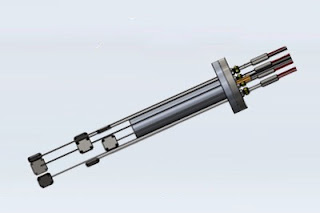
heater and sensor
Example of an integrated heater and thermowell with multiple
sensors to be matched with a control system for
highly accurate heating. Courtesy of BCE.
The control system is one of the primary components of a thermal system, along with the heating source (ex. electric heater) and the sensing element (ex. thermocouple or RTD). Proper selection of the control system is critical to accurate control, efficiency and performance.

Temperature gradients and fluctuations occur during heat up, cool down, and when process load is applied. These are mitigated by proper placement of the heating source, location of the sensing element, and control mode chosen.

Thermal system stability is maintained by carefully balancing the energy applied to the process media in opposition to the energy adsorbed by the process and all the radiant, conductive, and convective losses in the system.

For example, an electric heater's "power" is rated in watts, and the power density is stated in watts per square inch. In an ideal thermal system, the energy provided by the electric heater (in watts) would equal the energy lost from all the surfaces and work-related losses at the desired temperature. However, the world is not ideal, and additional external variables affect close temperature control. Hence, the need for control systems.

Control systems regulate in two ways: 1) by regulating the amount of energy (electricity or fuel) added to a process; and 2) by regulating the time the full energy source is applied. When talking about electric heaters, an example of power regulation is the use of thyristor power controllers that modulate the voltage delivered to the heater. An example of time-based power control is the use of solid state (or mechanical) relays and proportioning the amount of time-on, versus time-off, that full power is applied.

Recommendations for optimal thermal system control:

  1. Use adequate insulation when and where possible to reduce radiant and convective surface losses.
  2. Design the thermal system with the heating source, sensing element and process media as compact and near one another as possible.
  3. For thermal systems that are likely to have large overshoot, consider using cascading control that governs the power output based upon multiple sensing locations.
  4. Carefully consider the thermal system control mode you choose for the application, i.e. simple on-off control or some variety of energy proportioning.
  5. Sensor position is very important. The sensor should be placed as close to, or immersed in, the critical area of your process media, or where a good average temperature can be obtained.
  6. Consider the thermal conductivity of your process media and base your sensor location accordingly. You may have to test several locations.
Contact BCE with any question or requirement for electric heaters or thermal system design. Call 510-274-1990 or visit https://belilove.com.

Welcome to BCE

BCE (Belilove Company-Engineers) has over 60 years experience as a California based manufacturer, value added component integrator, and distributor serving the analytical instrumentation, semiconductor, photovoltaic, medical equipment, plastics processing, foodservice equipment, packaging, and aerospace industries. 

BCE offers custom electrical heaters, sensors, controls and custom vacuum feedthroughs for sale. Supported by their wealth of knowledge and experience, BCE will assist you with your electric heating, vacuum feedthrough, and ceramic substrate needs.

http://www.belilove.com | (510) 274-1990

Need a Custom Design Electric Heating Element? Call Your Local Heating Element Sales Rep

Your Local Heating Element Sales Rep is Your Friend
Your local heating element sales rep is your asset.
Many design engineers at original equipment manufacturers (OEMs) may overlook a huge asset when designing a new piece of equipment requiring an electric heater. The local heating element sales representative.

Custom heating element design is best completed and accomplished through the proper application of the right resources. The local heating element sales engineer is an access point to high level technical knowledge and assistance that can be easily tapped and brought to bear on your successful task or project completion.

Local heater and control distributors and representatives provide services that will help you save time and money, with a greater chance of achieving a better outcome for the entire project. 

Consider these points regarding what the heating element sale rep brings to your project:
Custom heating element design
Example of custom heating element
(ceramic airflow heater)
  • Product Knowledge: The heating element sales rep will be current on product offerings, proper application, and capabilities. They also have information regarding what products may be obsolete in the near future. This is an information source at a level not generally accessible to the public via the Internet. 
  • Application Experience: As a project engineer, you may be treading on fresh ground regarding some aspects of your current assignment. There can be real benefit in connecting to a source who has decades of designing electrical heating elements. 
  • Access: Through a heating element sales rep, you may be able to establish a connection to “behind the scenes” manufacturer contacts who will champion your project internally. The rep knows people, makes it his/her business to know the people that can provide answers, and can act as your projects ambassador with the manufacturer.
Certainly, any solutions proposed are likely to be based upon the products sold by the representative. That is where considering and evaluating the benefits of any proposed solutions become part of achieving the best project outcome.

Develop a professional, mutually beneficial relationship with a heating element sales rep. Their success is tied to your success and they are eager to help you.


On-Off Temperature Control Using PLC Ladder Logic

on off control
Diagram of on / off control.
In control theory, an on–off controller is a feedback controller that switches abruptly between two states. It is often used as a control method for a process which can tolerate an ongoing, changing band of change, referred to as the hysteresis. A very common example for temperature are residential thermostats. They control the temperature of your home, turning off at your comfort setting, then after some significant change occurs, and they turn on again to eliminate that difference. The process cycles continually.

A common method of temperature control is an on/off control system using comparison instructions in a PLC program where outputs are energized until the set point is reached.

The video below provides a temperature control example where the heater turns on when the temperature falls to or below 597 degrees, and turns off when the temperature reaches 603 degrees or more.

To control the circuit, S1 is programmed in the heater output circuit. Addressed to the move instruction is a thermocouple that provides an analog value to the temperature. The temperature is moved from the source to the destination when S1 is activated and is displayed on the LED panel.

Using the less than or equal to, and greater than or equal to, instructions addressed to the same integer file the source values have A and B are compared to control the heater. With source a less than source be at the less than equal to instruction, the low temp and heater outputs are enabled. The heater remains on as long as the low temp output is true and the high temp output is false.

As the temperature rises above source B at the less than or equal to instruction, low temp turns off and heating continues. Reaching 603 degrees or more, the high temp output is enabled, since source A is equal to source B of the greater than equal to instruction.

When the high temp output is true, the heater turns off and remains of until the temperature reaches 597 or lower.  The cycle is repeated to maintain the average set point temperature at the other at 600 Fahrenheit.


Suggested Watt Densities for Electric Heating Elements

watt density in electric heaters
Always consider proper watt density
for your electric heater application.
Reprinted with permission from Hotwatt

The rates below are recommended watt densities for use with various materials. Safe values vary with operating temperature, flow velocity, and heat transfer rates. In general, the higher the material temperature, the lower the watt density should be, especially those materials which coke or carbonize, such as oils. Watt densities should be low if a material is being heated to a temperature near where the change of state to a vapor occurs (water to steam @ 212°F) since the vapor state has much poorer heat transfer capabilities.

Material being heated Maximum Operating Temp.°F Maximum Watts Per Sq. In.*
Acid Solutions:
   Acetic
   Chromic (5%)
   Citric
Ferric
   Chloride (40%)
Hydrochloric
Nitric (50%)
Sulphuric

212
Boiling
Boiling
Boiling

150
Boiling
Boiling

40
40
40
40

30
40
30
Alkali & selected oakite cleaning solution 212 40
Asphalt binder, tar, other viscous compounds 200
300
400
500
8
7
6
5
Caustic Soda 2%
                    10%
                    75%
210
210
180
45
25
25
Coffee (Direct Immersion) Boiling 90
Dowtherm A®
   flowing at
   1 ft/sec or more
   Non-flowing


750
750


22
10
Ethylene glycol 300 30
±Fuel Oils
   Grades 1 & 2 (Distillate)
   Grades 4 & 5 (Residual)
   Grade 6 & Bunker C
   (Residual)
200
200
160
22
13
8
Gasoline, kerosene 300 20
Glue (heating indirectly using water bath Lead-Stereotype pot) 600 35
on
casting
Liquid ammonia plating baths 50 25
** Lubrication Oils
   SAE 10, @ 130°F
   SAE 20, @ 130°F
   SAE 30, @ 130°F
   SAE 40, @ 210°F
   SAE 50, @ 210°F

250
250
250
250
250

22
22
22
13
13

* * Some oils contain additives that will boil or carbonize at low watt densities. Where oils of this type are encountered, a watt density test should be made to determine a satisfactory watt density.


Material being heated Maximum Operating Temp.°F Maximum Watts Per Sq. In.*
Metal melting pot 500 to 900 20-27
Mineral oil 200
400
20
16
Molasses 100 2-3
Molten salt bath 800-950 40
Molten tin 600 20
Oil draw bath 600
400
20
24
Paraffin or wax 150 16
Photographic solutions 150 70
Plating solutions:
   Cadmium plating
   Chrome plating
   Copper plating
   Nickel plating
   Tin plating
   Zinc plating

40
40
40
40
40
40
Salt Bath 900 30
Sea Water Boiling 90
Sodium cyanide 140 40
Steel tubing cast into aluminum 500 to 750 50
Steel tubing cast into iron 750 to 1000 55
Heat transfer oils
   flowing at 1 ft/sec or more
500
600
650
750
22
22
22
15
Trichloretylene 150 20
Vapor degreasing solutions 275 20
Vegetable oil (fry kettle) 400 30
Water (process) 212 60
Water (washroom) 140 80-90

* Maximum watt densities are based on heated length, and may vary depending upon concentration of some solutions. Watt density should be kept as low as possible in corrosive applications since higher watt densities accelerate corrosive attack on element sheaths. Consult BCE for limitations.

Important: The above values are estimates. It is strongly suggested that you discuss your requirement with an application expert before you apply any electric heating element in to a process where the proper watt density is unknown.

When You Need a Custom Heating Element or Thermal System Design

OEMs often need custom designed heating elements for their equipment. Designing an electric heating element, or a complete thermal system, requires both electrical and mechanical engineering skills. Often, you can save time and money by calling in an expert with the proper experience to assist.

Belilove Company-Engineers has decades of experience developing custom thermal solutions in many industries - from low tech to cutting-edge high tech, from foodservice appliances to semiconductor processing equipment, Belilove has "been there, done that". So the next time you need an electric heating element, temperature sensor, or controller, Think Belilove.


Thermocouple Basics - Wire Type, Connectors, Construction

Industrial thermocouples, as the temperature sensor in a thermal system, are explained in the video below.

Seebeck Effect
Seebeck Effect
(image courtesy of Wikipedia)
Thermocouple "Types", based upon standardized color designations is discussed, as well as thermocouple connectors, polarity and some aspects of construction (such as grounded vs. ungrounded vs. open tip).

Thermocouples are a fairly accurate, economic temperature sensor used in many industrial applications. They operate on the "Seebeck Effect" which is the phenomena of dissimilar metal conductors producing a measurable voltage difference between two substances.

Thermocouples are used widely in industrial thermal system design in industries such as power generation, primary metals, pulp and paper, petro-chemical, and OEM equipment.


For more information contact:
Belilove Company Engineers
21060 Corsair Blvd
Hayward, CA 94545
Phone: (510) 274-1990
Fax: (510) 274-1999
E-mail: sales@belilove.com

Thick Film Heating Elements: An Excellent Choice for Custom OEM Thermal Designs

custom thick film heaters
Custom Thick Film
Heaters and Circuits
Thick film heating elements, originally designed for the automotive and military industries, are manufactured by depositing several layers of conductor, resistors and dielectric on to an insulator via a screen printing process. The dielectric is normally some type of glass or ceramic and provides electrical insulation for the screen printed heating tracks.

Thick film heating elements are almost always custom designed for OEM applications. They can be designed in all shapes and sizes, and have an ability to provide very high watt densities with excellent controllability. The largest markets for these heating elements are appliances, analytical instruments, automotive, semi-conductor, medical device, scientific and military equipment.

Because of their inherent low mass, and their ability to carry high watt densities, thick film heaters are very efficient and are an excellent choice where a rapid heat-up (response) is required.

Advantages of thick film heaters are:
  • Watt-Density up to 175 watts per sq. in. 
  • Operating Temperature to 500 deg C
  • Low Profile
  • Excellent Control
  • Very uniform heat profile
  • Temperature sensors can be included on the heater
  • Custom heating profiles
  • Very rapid heater response
  • Vibration and shock resistant
  • Very customizable shapes, sizes and wattages

Custom Electric Heaters for Unique Thermal Systems Require the Right Thermal System Partner

Thermal System PartnerOEMs in the analytical, semiconductor, biomedical, life-science, food service and environmental industries continually design new pieces of equipment offering their customers greater efficiencies, smaller foot prints and greater production rates. When the piece of OEM equipment requires precise heating, consultation with an experienced thermal systems engineer will provide significant time savings and budget control.

More specifically, working with an experienced thermal system consultant provides these important benefits: front-end, practical design review to optimize manufacturability; timely prototype development; partnerships and alliances with platers, brazers, casters and heating element manufacturers; single source responsibility; testing and calibration; inventory management; value-added assembly; and cleaning and packaging.