Showing posts with label thermocouple. Show all posts

The Operating Principle of Thermocouples

When two dissimilar metal wires are joined together at one end, a voltage is produced at the other end that is approximately proportional to temperature. That is to say, the junction of two different metals behaves like a temperature-sensitive battery. This form of electrical temperature sensor is called a thermocouple:


This phenomenon provides us with a simple way to electrically infer temperature: simply measure the voltage produced by the junction, and you can tell the temperature of that junction. And it would be that simple, if it were not for an unavoidable consequence of electric circuits: when we connect any kind of electrical instrument to the thermocouple wires, we inevitably produce another junction of dissimilar metals. The following schematic shows this fact, where the iron-copper junction J1 is necessarily complemented by a second iron-copper junction J2 of opposing polarity:


Junction J1 is a junction of iron and copper – two dissimilar metals – which will generate a voltage related to temperature. Note that junction J2, which is necessary for the simple fact that we must somehow connect our copper-wired voltmeter to the iron wire, is also a dissimilar-metal junction which will also generate a voltage related to temperature. Further note how the polarity of junction J2 stands opposed to the polarity of junction J1 (iron = positive ; copper = negative). A third junction (J3) also exists between wires, but it is of no consequence because it is a junction of two identical metals which does not generate a temperature-dependent voltage at all.

The presence of this second voltage-generating junction (J2) helps explain why the voltmeter registers 0 volts when the entire system is at room temperature: any voltage generated by the iron-copper junctions will be equal in magnitude and opposite in polarity, resulting in a net (series-total) voltage of zero. Only when the two junctions J1 and J2 are at different temperatures will the voltmeter register any voltage at all.

For more information about thermocouples (or any temperature sensor), contact BCE. They can be reached by calling 510-274-1990 or by visiting their web site at https://bcemfg.com.

Reprinted from "Lessons In Industrial Instrumentation" by Tony R. Kuphaldt – under the terms and conditions of the Creative Commons Attribution 4.0 International Public License.
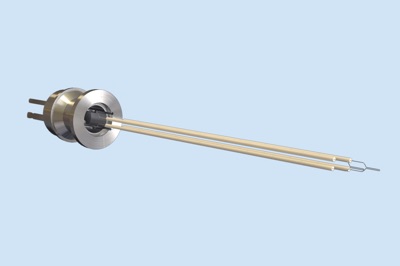
Twin Type-C Thermocouple, High Temperature, High Vacuum Feedthrough

Twin Type-C Thermocouple FeedthroughBACKGROUND

An application was presented to BCE in the semiconductor equipment industry for a high temperature, high vacuum thermocouple (TC). There was space limitation with a requirement for a multi-point TC to sense a very small insertion dimension. The TC probe area must be able to bend to allow the sensor tip to penetrate the temperature sensing zone. The BCE engineers and technicians were ready for the challenge with their experience in ceramic-to-metal sealing and high temp sensors.

SCOPE
  • Twin Type-C Thermocouple Vacuum Feedthrough needed to satisfy the following criteria:
  • <1425°C continuous operating temperature in probe area
  • Two independent type “C” thermocouple probes
  • KF16 Flange
  • Vacuum rating: 10 9̄ ATM-CC/Sec
  • Feedthrough Seal Temp: -25°C to 300°C
  • Probe section needs to be bendable and vacuum compatible with SEMI standard
  • ALL TESTS PERFORMED AT ROOM TEMPERATURE
OUTCOME

BCE designed an effective High Temperature Vacuum TC that was delivered for prototyping and customer testing. The application requirement was met and the function was sound. All tests performed prior to shipping were completed at BCE. A standard operating procedure (SOP) was finished and the part is production ready.

More information on this BCE product can be found at this link. 

BCE
https://bcemfg.com
510-274-1990

FAQ: Custom Heater Assemblies

Custom Heater Assemblies
Custom heater assembly that includes a sealed cartridge
heater, thermowell, and thermocouples (multiple).

What is a custom heater assembly?

In general terms, a custom heater assembly is a device that transforms electrical current to heat energy, is designed in a way that accommodates the needs of a unique heating requirement, and is used for the heating of gases, liquids, plastics, or metals.

What is a thermowell?

A thermowell is machined metallic tube used to house and protect sensors or heating elements. Thermowells not only protect heaters and sensors from erosive or corrosive media, they also allow for easy removal and replacement without exposing the process media.

What is a cartridge heater?

A cartridge heater is a cylindrically shaped electric heating element intended to be inserted in holes in metal platens or immersed in flowing media. The design incorporates a ceramic bobbin wound with nichrome resistance wire, carefully centered inside a metallic tube, and then backfilled with magnesium oxide (MgO), which provides electrical insulation. Cartridge heaters can be either swaged (compacted MgO) or un-swaged (loosely filled MgO). Swaging allows for maximum heat transfer to outside surfaces while keeping internal heater temperatures as low as possible, and preserving dielectric qualities.

What is a sealed cartridge heater?

A sealed cartridge heater incorporates all of the characteristics of a standard cartridge heater but is additionally sealed with BCE’s proprietary epoxy seal making it vacuum compatible. The seal additionally elongates heater life, especially in high humidity and moisture environments.

What electrical tests are performed on heaters?

Heaters undergo 3 main electrical tests: Resistance, MegOhm and Hipot.

A resistance test is performed using a fluke meter to ensure that the heater is manufactured within the correct tolerances of the electrical specifications. Heater leads are connected directly to the fluke meter leads to perform the test.

A MegOhm or Insulation Resistance test is performed using a megohmmeter. As its name implies it tests for any breakdown in a heater’s insulating material. The test is performed by supplying low to medium voltage to the insulating material for a small period of time.

A Hipot test is also used to assess the dielectric strength of the heater’s insulating material. In addition to performing a Dielectric Withstand Test like the Megohm, it can also perform a Dielectric Breakdown Test. This means that the heater insulating material is shocked at very high voltages until failure is achieved. This is more commonly performed on samples as it destroys the heater.

What is a thermocouple?

A thermocouple is a thermoelectric device that measures temperature. When the wire junction of its two dissimilar metals changes in temperature, a small voltage is created. The voltage is then used to calculate the temperature using the thermocouple’s reference table.

What is an RTD?

RTD stands for "resistance temperature detector". It is generally constructed of a fine and pure metallic wire wound around a ceramic or glass core. The relationship between wire resistance and temperature is used to sense the temperature of other devices.

Replaceable, (10) Type K Thermocouple, Vacuum Feedthrough

10 Thermocouple Vacuum Feedthrough
Thermal sensing inside a vacuum chamber is essential in many processes. It is therefore necessary to have a feedthrough that not only ensures vacuum compatibility, but which also allows easy replacement and maintenance of thermocouples and components. This is precisely what BCE’s Replaceable 10X Thermocouple Feedthrough renders.

With 10 thermocouples installed inside stainless steel compression fittings, multiple temperature readings can be taken from inside the vacuum chamber simultaneously. As the thermocouples are compressed, they can be easily extracted for maintenance or replacement purposes. The compression fittings in turn are threaded into a standard CF flange with an O-ring groove that mates directly to the chamber port. Thus, they can also be removed and replaced with ease. 

The entire construction is stainless steel for added durability and cost effective machining of parts. Thermocouple leads are available in multiple materials including Kapton for higher temperature applications. Hence, there is virtually no contamination.

Specifications
  • CAD modelling and Engineering Design Consultation for R&D 
  • Vacuum Compatible to 10-9 atm.cc/sec 
  • Maximum Operating Temperature up to 400°C (dependent on lead insulation and O-ring materials) 
  • 10X Thermocouple, Type K, Grounded, SS304 sheath (multiple options available) 
  • 10X 316 SS compression fittings (multiple options available) 
  • 304 SS standard CF flange with O-ring groove (multiple options available) 
  • 24” standard Teflon leads (multiple options available) 
  • All features and materials can be customized

Replaceable, Flanged, Multi-Thermocouple Vacuum Feedthroughs

Multi-Thermocouple Vacuum Feedthrough
(Click for larger view)
One of the biggest challenges facing the vacuum industry is to collect multiple readings from complex assemblies while being limited by the number of existing feedthrough ports in a vacuum chamber. With BCE’s Multi-TC, Flanged Feedthrough, companies no longer need to invest in adding more ports for a greater collection of temperatures from a vacuum environment as multiple thermocouples are embedded in just one feedthrough. The number, type and lengths of the thermocouples can be altered to match specific application requirements meeting each customers’ unique needs. As the thermocouples can be adapted to meet unique design constraints, so can this feedthrough’s flange. All sizes used are standard and are easily mountable with readily available hardware. No complicated assemblies are required for the most complicated of vacuum setups.

With most vacuum feedthroughs, troubleshooting can be difficult as well when multiple fixed elements are involved. If one element fails, generally the entire vacuum feedthrough is rendered useless. With BCE’s Multi-TC, Flanged Feedthrough, arduous troubleshooting procedures are a thing of the past. In fact, this feedthrough’s thermocouples are replaceable as they can be extracted from the compression fittings with great ease. This means that if thermocouples fail, they can be removed, tested and replaced within minutes. Thus, this no-hassle design allows for faster, more accurate and more cost-effective thermal data collection. Trust BCE’s Multi-TC, Flanged Feedthrough for your most complicated thermal detection needs.

Specifications
  • Replaceable thermocouple(s) design 
  • Vacuum Integrity: 10-8 atm.cc/sec 
  • Multiple types and lengths available for thermocouple(s) 
  • Multiple types and sizes available for flange(s) 
  • Multiple types and sizes available for lead wires (KAPTON available for minimal contaminant release) 
  • Compatible O-rings available for flange(s) 
  • Can be adapted to virtually any temperature range
For more information, visit http://www.belilove.com/feedthrough.

Industrial Process Temperature Sensor Comparison

industrial thermocouples
Array of thermoucouple assemblies
Courtesy Durex
It's always useful to have quick references for things. Durex, a globally recognized manufacturer of electric heating solutions, published the Temperature Sensor Element Selection Guide included below in a recent blog posting. It provides a consolidated comparison of the four primary temperature sensing devices used for industrial process control. Many will find it useful, so we share it with you here.

All the technical expertise needed for your process heating challenges is readily accessible at BCE. Share your heating challenges with experts, combining your process and application knowledge with their expertise to develop effective solutions.


Thermocouple Basics - Wire Type, Connectors, Construction

Industrial thermocouples, as the temperature sensor in a thermal system, are explained in the video below.

Seebeck Effect
Seebeck Effect
(image courtesy of Wikipedia)
Thermocouple "Types", based upon standardized color designations is discussed, as well as thermocouple connectors, polarity and some aspects of construction (such as grounded vs. ungrounded vs. open tip).

Thermocouples are a fairly accurate, economic temperature sensor used in many industrial applications. They operate on the "Seebeck Effect" which is the phenomena of dissimilar metal conductors producing a measurable voltage difference between two substances.

Thermocouples are used widely in industrial thermal system design in industries such as power generation, primary metals, pulp and paper, petro-chemical, and OEM equipment.


For more information contact:
Belilove Company Engineers
21060 Corsair Blvd
Hayward, CA 94545
Phone: (510) 274-1990
Fax: (510) 274-1999
E-mail: sales@belilove.com

Thermocouples, RTD's and Thermistors

This post explains the basic operation of the three most common temperature sensing elements - thermocouples, RTD's and thermistors.

A thermocouple is a temperature sensor that produces a micro-voltage from a phenomena called the Seebeck Effect. In simple terms, when the junction of two different (dissimilar) metals varies in temperature from a second junction (called the reference junction), a voltage is produced. When the reference junction temperature is known and maintained, the voltage produced by the sensing junction can be measured and directly applied to the change in the sensing junctions' temperature.