Showing posts with label customer heater design. Show all posts

Custom Electric Heating Elements Provide OEM Designers Freedom and Flexibility

Custom Electric Heating Element
Custom heater for vacuum
applications
with thermowell
and multiple RTD sensors.
Technology advances rapidly and new discoveries in material science, medicine, pharmacology, biology and semiconductors are being made every day. Along with these advancements in  technology comes new treatments, medicines, materials, and processes.

Original equipment manufacturers (OEM's) of analytical, semiconductor, biomedical, life-science, and aerospace equipment continually design new equipment to apply and leverage these discoveries. Pressure to produce new machines offering greater efficiencies, compactness, and greater production is always present. Each item in the precedent design undergoes scrutiny and very often has be modified to a new fit, form, or function.  New components are needed to meet the new design requirements.

The application of localized electric heating elements is one area that OEM design engineers find themselves navigating in unchartered waters. Very logically, they often attempt to use an off-the-shelf cartridge, silicone rubber, or mica heaters for their specialized heating requirement. Unfortunately this approach leads to compromises in layout, packaging, and performance. A much better alternative is considering a custom heating element, developed in consultation with an experienced custom heater manufacturer.
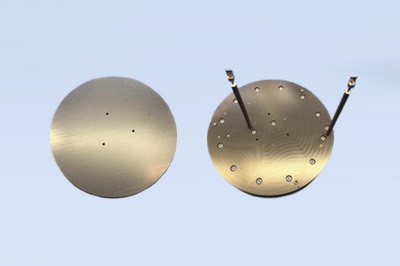
Custom Electric Heating Element
Custom semiconductor wafer
chuck heater
. Highly uniform heat
with no brazing or casting. 
Experienced custom electric heater designers provide many important benefits throughout the entire product development cycle. For instance:
  • Front-end, practical design review to optimize manufacturability.
  • Timely prototype development.
  • Partnerships and alliances with platers, brazers, casters and heating element manufacturers.
  • Single source responsibility.
  • Testing, calibration, and QC.
  • Inventory management.
  • Value-added assembly.
Custom Electric Heating Element
APCI Heater/Capillary Source Heater
400 deg. C, connector
plug, and internal RTD sensor.
The heater manufacturer partner provides critical guidance in areas such as material selection, power requirements under load, temperature vs. time data, watt density and packaging. With their help, high performance, precise fit, and long heater life are better ensured.

By choosing a custom electric heating element design, the OEM gets exactly what they need in terms of form, fit, and function plus scores of other benefits derived from the heater vendor's tacit knowledge and past experiences.

Handy Electric Heating Engineering Constants and OHMs Law

Here is a very handy "cheat-sheet" for calculating Ohm's Law and other engineering constants that come in very handy when calculating wattages, voltages and current draw of electric heating elements.

These equations are important when sizing any type of electric heating element including cartridge, band, immersion, or flexible heaters.

To calculate any wattage, voltage or current, you need to know two of the variables and refer to the diagram in the document to calculate the third.


Another important quick reference chart is Fahrenheit to Centigrade temperature conversion as shown below.


Basics of OEM and Industrial Electric Heating Elements - Part 2

This blog entry, reproduced from an electric heating element basics white-paper from Hotwatt, a leading US manufacturer of OEM and industrial heating elements. To download the PDF version, click this link.

Basic Heat Equations

electric heating elements
Electric Heating Elements
It would appear at first that calculating all of the heat transfers and losses in a design would be a daunting task. Fortunately a number of equations were developed that help simplify this task. First the equations were divided into three tasks: the wattage needed to heat a material to a specific temperature in a given amount of time; the wattage needed to overcome the losses at operating temperature; and a special calculation needed to reach a melting or vaporizing point.

This equation calculates the amount of wattage (W) needed to raise the temperature of a material a specific amount in °F (ΔF) in a given number of hours (T), you first need to know the mass (m) of the material being heated and its specific heat value (c):

m × c ×ΔF
W=  -------------------
3.412 × T

The mass and specific heat of some materials may be found at www.hotwatt.com/table1.htm for metallic solids, www.hotwatt.com/table2.htm for solids other than metals, and www.hotwatt.com/table3.htm for certain liquids and gases.

Basics of OEM and Industrial Electric Heating Elements - Part 1

This blog entry, reproduced from an electric heating element basics white-paper from Hotwatt, a leading US manufacturer of OEM and industrial heating elements. To download the PDF version, click this link.

Electric heating elements for OEM and Industry
Electric heating elements
for OEM and Industry
(courtesy of Hotwatt)
The simplest definition of an electric heater is any device that changes electrical energy into heat energy. But from that simple explanation, electric heaters explode into a myriad of types, sizes, applications, and designs depending upon what’s being heated, the degree of heating needed, and the method by which the heat is applied.

The measure of electrical energy is called the Joule after its discoverer, James Prescott Joule. Through numerous experiments, Joule determined that the quantity

(Q) of heat transferred from electrical energy is proportional to the square of the current (I2 ) multiplied by the resistance (R) for the period of time (t) through which it passes:

Q ∝ I2 × R × t

However, one seldom sees a reference to Joules used in modern electric circuits. Instead, the controlling factor becomes that of power (P):

P = I2 × R

You’ll note the only difference between the formula for determining power and that of determining Joules is the time component. The time factor in heating becomes readily apparent in any device that gets hot when an electric current flows through it: its temperature rises as time passes.

Custom Electric Heaters for Unique Thermal Systems Require the Right Thermal System Partner

Thermal System PartnerOEMs in the analytical, semiconductor, biomedical, life-science, food service and environmental industries continually design new pieces of equipment offering their customers greater efficiencies, smaller foot prints and greater production rates. When the piece of OEM equipment requires precise heating, consultation with an experienced thermal systems engineer will provide significant time savings and budget control.

More specifically, working with an experienced thermal system consultant provides these important benefits: front-end, practical design review to optimize manufacturability; timely prototype development; partnerships and alliances with platers, brazers, casters and heating element manufacturers; single source responsibility; testing and calibration; inventory management; value-added assembly; and cleaning and packaging.