An instructional blog about specialized electric heating elements and vacuum feedthroughs for the OEM, analytical, semiconductor, aerospace, pharmaceutical, chemical, water, environmental, food processing, and alternative energy markets. Please feel free to contact us at (510) 274-1990 with any questions. BCEmfg.com
The BCE Hi-Temp Puck Heater
Experienced Electric Heating Element Designers Speed Development Time and Save Money in OEM Product Development
Technology advances rapidly, and findings in material science, medicine, pharmacology, biology, and semiconductors occur daily. These advancements in technology open the door for performance improvements leading to new treatments, medications, materials, and processes. Original equipment manufacturers (OEM's) of analytical, semiconductor, biomedical, life-science, and aerospace equipment continually design new equipment to apply and leverage these new discoveries.
Experienced custom electric heater designers provide many essential benefits throughout the product development cycle. For instance:
- Front-end, practical design review to optimize manufacturability.
- Timely prototype development.
- Strong alliances with vendors.
- Single source responsibility.
- Testing, calibration, and QC.
- Inventory management.
- Value-added assembly.
The heater manufacturer partner provides:
- Critical guidance in material selection.
- Power requirements under load.
- Temperature vs. time data.
- Watt density optimization.
- Packaging advice.
Their help provides high performance, precise fit, and extended heater life.
The pressure to produce new devices that offer greater efficiencies, compactness, and production is always present. Each item in the precedent design undergoes scrutiny and transitions to a contemporary fit, form, or function. New components are needed to meet the new design requirements. By choosing an experienced custom electric heating element design partner, the OEM gets the precision they need, plus scores of other benefits derived from the heater vendor's tacit knowledge and past experiences.
Sunrod Split Sheath Miniature Cartridge Heaters
- Small footprint, high heat
- 1/8 inch and 4MM diameters
- 3 - 240 volt operation
- Hundreds of sizes In stock
- Heaters as short as 1/2"
Sunrods have a unique hot tip that allows you to reach any part of your operation that requires heat.
When activated, the split sheath design of SunRod forces its opposing legs to extend into contact with the surrounding bore for optimal heat transfer resulting in reduced operating temperature and an extended operating - by up to five times!
SunRod elements contract when de-energized, breaking contact with the bore and allowing slide-out removal. SunRods are never going to seize!
You may now apply heat whenever you want! Drill a small bore to the area that requires heating and insert a hot tip SunRod.
Contact BCE for more information about Sunrod split sheath miniature cartridge heaters. Call 510-274-1990 or visit https://bcemfg.com.
Molybdenum-Copper Stage Heater
BACKGROUND
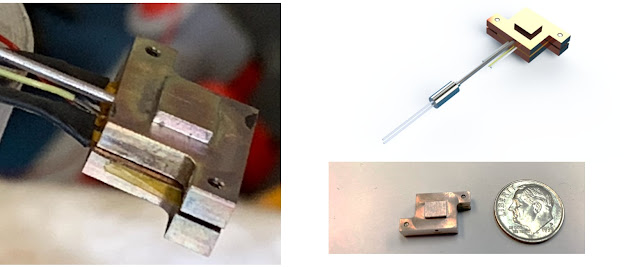
A research and development company approached BCE wanting to heat a 1mm x 1mm x 0.5mm thick component. This was a very sensitive part that needed to be tested to a maximum exposure of 200°C continuous with very precise temperature uniformity for sampling purposes.
SCOPE
Molybdenum-Copper Stage Heater needed to satisfy the following:
- Temperature <201°C
- Internal element must be able to withstand temperature <210°C
- A cold section was not needed
- Molybdenum-Copper (Moly-Copper) base 65% Moly and 35% Copper
- 12Volt, 3Watt (Max)
- Two thermocouple type “K” external
- M1 threads
OUTCOME
BCE produced a highly effective assembly which reached the temperature of 200°C in under 1-Minute utilizing only 2.6 watts. Because of the low mass and high conductivity of the copper-moly base, reaching the target temperature and cooling down was highly efficient.
There were two thermocouples which were used to verify the test temperature. One was an exposed bare-bead TC 36 AWG, with the second TC being a 0.062ӯ probe style unit. The M1 threads were challenging, however our process was able to make this happen.
GET MORE INFORMATION ABOUT THE CUSTOM MOLYBDENUM-COPPER HEATER HERE
Call BCE today for more information.
510-274-1990
https://bcemfg.com
BCE Cartridge Heaters
BCE manufactures a wide range of cartridge heaters for a variety of industrial applications, and can provide you with heaters manufactured to your exact specifications. Cartridge heater size, sheath, leads, terminals, wattage and voltage can all be adapted to meet your exact needs.
Low to Medium Watt Density Cartridge Heaters
BCE precision cartridge heaters provided localized heat to restricted work areas requiring close thermal control. Dies, platens, and a variety of other types of processing equipment are efficiently heated and can be closely controlled. Part work temperatures of up to 1250ºF are obtained by a combination of heater location and proper wattage output. Basic heater designs are readily adaptable to a wide variety of special requirements, sizes, or ratings. Heating element wires are constructed just beneath outside surface for optimum heat transfer and minimum core temperature, resulting in faster part heating.
The maximum power densities for low to medium watt density cartridge heaters is computed at 60 watts per square inch of heated surface. With proper fit in a heat sink, long life can be expected. Consult BCE for higher watt density applications. Lower watt density will result in longer life. Standard voltages are either 120V or 240V. Other voltages are available.
High Watt Density Cartridge Heaters
The useful life of a Cartridge heating element is determined by how quickly the heat generated in the internal resistance wire can be dissipated to the outside sheath. BCE high watt density cartridge heaters are design and constructed in a way that accelerates the transfer of heat from the resistance wire to the sheath. This is accomplished by relocating the wire so that it is closer to the sheath; and swaging the outside diameter of the heater, thereby compressing the magnesium oxide filler so that it becomes an improved conductor of heat from the wire while maintaining its dielectric properties. By improving the heat transfer rate, it is possible to manufacture elements of higher densities because the differential between the wire temperature and the sheath temperature has been minimized.
Common applications for high watt density cartridge heaters are dies, heat sealing machines, hot melt adhesive equipment, plastic molding machines, platens, and shoe machinery.
Optimizing Performance and Operating Life of High Watt Density Cartridge Heaters
Cartridge Heater Fit
High watt density heaters require careful fit to insure optimum performance and long life. BCE recommends that installation holes not be drilled and reamed over .002” or larger than the nominal hole size required.
Cartridge Heater Cycling
Rapid cycling of heaters from very low to very high temperatures shortens their life considerably. It is recommended therefore, that care be taken to compute the correct wattage for any given installation. Optimum wattage should result in a 50/50 off/on cycle.
Location of temperature Sensor and Cartridge Heater
When thermostats are used, the sensing element ought not to be placed further than 1⁄2" away from the heater wherever possible.
For more information about cartridge heaters, call BCE at 510-274-1990 or visit their website at https://bcemfg.com.
Custom Electric Heating Elements for Aerospace, Satellites, and Space Exploration
BCE applies specialized know-how in top level design and production to supply electrical heating technologies for applications in the fields of aerospace, satellite communications and space exploration.
Providing electric heaters to the aerospace, satellite communications, and space exploration industries require pristine accuracy and conformance to exacting specifications. Heating elements must be designed to handle extremes in temperatures, shock and vibration, comply with exacting weight and size requirements, and be capable of operating in vacuum environments - all while still providing fail-proof performance.
BCE has decades of engineering and design experience in developing custom electrical heating elements for these industries. BCE's expertise has been called upon to solve many difficult application challenges unique to these applications, including viscosity control, condensation prevention, freeze protection, as well as air and gas heating.
BCE controls the entire manufacturing cycle including design, production and testing. Their understanding of electric heating technology, and the innovation accumulated along the way, is built upon decades of working closely with customers, meeting their critical requirements. Components and materials are carefully selected according to the customers’ exact specifications, many time turning out to be more than just the heating element itself. Products can be supplied as full assemblies complete with mechanical components, connectors, and sensors with batch sizes from a single piece to large volumes.
Contact BCE with any challenging electrical heating application in the aerospace, satellite communications, and space exploration field. You'll be glad you did.
BCE
https://bcemfg.com
510-274-1990
Electric Heating Elements: Cartridge Heaters
![]() |
| Click for larger view. |
Cartridge Heater Basics
Cartridge heaters are cylindrical in shape, consisting of an element made of resistance wire wound around a ceramic core. Within a metal sheath tube, the wound core is precisely centered and surrounded by granular magnesium oxide material. This isolates the resistance element from the tube electrically and provides a heat transfer medium to the sheath tube. At one end are electrical terminations. In order to enhance internal heat transfer and electrical insulation characteristics, higher performance, longer-lived cartridge heaters are swaged (a rotary hammer compacting process). Swaging compacts and densifies the granular insulating material, improving its thermal conductivity. Cartridge heaters are commonly used and are produced in a broad range of lengths, diameters, wattages, watt densities, lead agreements, and optional internal sensors.
Cartridge Heater Applications
![]() |
| Specialized Cartridge Heater (BCE) |
Cartridge heaters are capable of operating at elevated temperature as well as high watt density, but care must be taken to apply cartridge heaters at appropriate watt density and sheath temperature levels.
Temperature Capability
A maximum of 1600°F (870°C) sheath temperature is recommended.Watt Density Capability
A maximum of 400 W/in. and higher under special conditions. As a rule, cartridge heaters can operate at 1600°F at 40W/in.Heater Life
Operating at 1600°F internal temperature with modest cycling and with the proper hole fit, a properly designed and constructed cartridge heater will provide approximately a one-year life.Voltage
Usually 120/240V, with 480V and custom voltages requiring special design or sizing considerations.Thermal Response/Application
Cartridge heater's thermal response is dependent on conductive heat transfer in most applications. Optimum conduction requires close fit between the heater and the work to be heated. As heater looseness increases, watt density must be decreased accordingly, to prevent internal overheating. Watt densities of liquid-immersion cartridge heaters vary according to the liquid's viscosity and heat capacity. When heating liquids, care must be taken to prevent "film boiling" where vapor bubbles create a thermal insulating effect and raise the heaters internal temperatures.Heater Efficiency
Cartridge heaters are 100% efficient when immersed.For more information about electric heating elements, contact BCE by calling 510-274-1990 or by visiting https://bcemfg.com.
BCE Smart Flow: for OEMs Who Need Very Precise, Uniform Heat
The Smart Flow is often customized to suit the exact power, electrical, and mechanical requirements of the application. BCE engineers are ready to provide application assistance to design and apply the perfect Smart Flow for your needs.
Smart Flow Heaters Applications Examples:
9 KW STEAM GENERATOR
![]() |
| 9.0 KW (2 Zone 4500W each) (+/-10%), 240V, 23.5" Internal Length |
7.5 KW STEAM GENERATOR
![]() |
| 7.5 KW (2 Zone 3750W each) (+/-10%), 240V, 31.5" Internal Length |
1.75 KW LUBE OIL HEATER
![]() |
| HEATER: 1750W(+/-10%), 120V, 22-23WSI, 31.5" Internal Length |
- Wetted parts constructed of 316 stainless steel standardly. Other materials available as options.
- Liquid flow passes over an enclosed heated body, does not contact the heating element directly.
- Multiple threaded fittings available: NPT, SAE, BSP & VCR
- Heater designed to provide very uniform heating.
- Made in U.S.A.
BCE Mini Clean Flow: An OEM Customizable Clean Gas and Fluid Heater
![]() |
| Click on Mini Clean Flow drawing image for a larger view. |
The BCE Mini Clean Flow electric heater is a very compact, fast responding electric heating element for liquids and gases used in the fuel cell, bio-med, laboratory, food, and pharmaceutical industries. Typical applications include: Parts cleaning; Critical fluid heating; Solvent replacement; Biomass extraction; Bio reclamation; Semiconductor processing equipment; and photoresist materials.
![]() |
| Click on Mini Clean Flow drawing image for a larger view. |
The Mini Clean Flow is often customized to suit the exact physical, mechanical and operational requirements of the application. BCE engineers are ready to provide application assistance to design and apply the perfect Mini Clean Flow for your needs.
![]() |
| Click on Mini Clean Flow drawing image for a larger view. |
These examples are just a few of the many custom configuration BCE has developed for customers.
![]() |
| Click on Mini Clean Flow drawing image for a larger view. |
OEM Equipment Manufacturers: Look Toward the Experienced Sales Engineer for Project Success
Sales engineers are a readily available resource of application knowledge. Unlike information pulled from the Internet, sales engineers possess real-time product information. They are also exposed to many different product applications and are a wealth of tacit knowledge. All readily available for sharing with their customers.
OEM design engineers often find themselves sailing in uncharted waters. In the application of electric heaters or feedthroughs for instance, designers don't always have a full grasp of heater or feedthrough design constraints. When these situations occur, the heater sales person provides a real benefit in teaching and advising the designer what is possible. Additionally, many sales engineers have access to unpublished product and application information, which can be hugely important when attempting to build a leading edge product.
Of course any solutions proposed are likely to be based upon the products sold by the representative, but the best sales people will share the virtues of their products openly and honestly. The best sales engineers will even admit when they lack the product or experience to solve the problem, but even in this situation, you can be sure their perspective will still be of value. The goal is to build a long-term, trusting relationship - one of value to both parties. Sales engineers are in the business of dealing with people and making the important connections between customers and manufacturers. They make it their business to know what’s going on with products, companies and industries.
As an engineer or purchasing professional responsible for the design and manufacture of OEM equipment, know that working closely with a vendor sales engineer will save you precious time and greatly improve the likelihood of successful project outcomes. Their success, and your success, go hand-in-hand.
Electric Heating Elements and Electrical Feedthroughs for OEM Applications
BCE offers OEM (original equipment manufacturers) custom electric heaters, feedthroughs and BCE OEM customers benefit from decades of thermal design and applications experience. With a reputation for fast prototyping, quick turnaround for pre-production runs, and an eye for cost-effective design, equipment manufacturers quickly discover that find BCE is a long-term, highly valued supplier/partner.sensors.
OEM Equipment Markets
- Aerospace
- Semiconductor
- Analytical Instruments
- Photovoltaic
- Medical Equipment
- Plastics Processing
- Foodservice Equipment
- Packaging
OEM Electric Heaters & Feedthroughs: Price, Delivery, Performance
Portable, Plug-and-Play Bench-top Electronic Temperature Controller
For more information, visit this page on the BCE site or contact BCE by calling 510-274-1990.
Save Time and Money in the Long Run: Choose a Custom Electric Heater When It Comes to Heating Clean and Ultra-pure Fluids
![]() |
| Custom heater for clean and ultra-pure fluids (from BCE) |
Each of these industries include manufacturing processes that require a small and efficient heating source as a component of their production. These heaters must be ruggedly designed, made from materials immune to process contamination, and be vacuum tight. The heaters will be subject to high temperatures, harsh solvents, and corrosive gases. Many times they must maintain a seal for full vacuum, demonstrate a unique heating profile, and maintain very close control.
Common requirements in these processes:
- Capable of handling high vacuum.
- High temperatures.
- Isolation the process media from heating element.
- Isolation from other area of contamination.
- Very accurate control, including internal sensors.
- Fast heat up and cool down.
Using stock screw plug immersion heater for these applications should be avoided. This category of heater will not stand up to the rigors of the application, as they are designed for general industrial service. They are not intended for high purity, will not meet material compatibility requirements, have poor controllability and are bulky in size.
The answer is in a custom high purity fluid heater designed with the specific process in mind.
Benefits of developing a custom fluid heaters are:
- Available in a variety of voltages.
- Available in a wide range of watt densities.
- Temperatures up to 350°C.
- Effective heated area can be profiled to generate a liner temperature profile.
- Vacuum compatible up to 1.0 x 10⁻⁸ STD. CC/SEC Helium.
- Can be provided with internal sensors (RTD or thermocouples).
- Can be glass lined for ultra pure gas application.
MEGA CLEAN FLOW Heater: Minimizing Toxic Emissions for Cogeneration
Using a small (~25HP) lean burn natural gas motor for cogeneration, our customer wanted to mitigate toxic emissions on the exhaust. The challenge is reducing Formaldehyde and Benzine output levels as well as reducing all other toxins without air-flow exposure to ni-chrome resistors.
- Exhaust air flow rates from 15cfm to 30cfm
- Inlet 2” NPT, outlet 2” NPT
- Engine loads for 25% to 100%
- Insulation of all inlet & outlet entries as well as process chamber
- Air-flow exposure to 304 or 316 stainless steel only
- Outlet temperature must be <288°C at ALL flow rates
- BCE Controllers needed for operating temp and
- 50 Meg-ohm isolation at 500 VDC
- Hi-pot 2E + 1K at 3mAmp
- ALL TESTS PERFORMED AT ROOM TEMPERATURE
Clean Gas and Liquid Stream Heating
![]() |
| Clean gas and liquid heater (BCE Mini Clean Flow) |
High purity gas and liquid heating is challenging. Heater designs have to address problems and concerns involving contamination, thermal efficiency, electrical isolation, controllability, size, and packaging. Gas and liquid heating applications can vary dramatically. Some applications are very difficult to control and size is always a concern. One of the toughest issues to overcome is the seemingly mutually exclusive requirement for smaller size and higher power.
![]() |
| General diagram of "clean flow" heater. |
Driven by innovation and competition, the need for hotter, cleaner, smaller and more efficient electric heaters is unceasing. One type of heater known as the "clean flow" has broad adaptability to many clean gas and liquid heating needs. It utilizes an internal heating element isolated from the process flow chamber, both electrically and physically. Best described as a "mini circulation heater", the heater's flow chamber, with inlet and outlet connections, completely protects the clean gas or liquid from external exposure and contamination. The internal heating element can run at fairly high watt densities to accommodate fast changing flow rates, while still maintaining a compact and efficient package. Internal RTDs or thermocouples can be incorporated to monitor temperature closely, or to protect the heater from over-temperature.
If you have questions about electrically heating clean gases or liquids, contact BCE by either visiting https://bcemfg.com or by calling (510) 274-1990.
The SMARTFLOW Circulation Heater - Highly Efficient Electric Heater Design for Heating Liquids
- Wetted parts constructed of 316 stainless steel (other material available)
- Liquid flow passes over an enclosed heated body.
- All threaded fittings are available as NPT, SAE, BSP & VCR
- Internal heater provides uniform heating.
- Made in U.S.A.
https://bcemfg.com
510-274-1990
Electric Heating Element Design: Nichrome Wire
![]() |
| Nichrome wire heating element inside a quartz tube. (Image courtesy of Wikipedia) |
Resistance (measured in ohms and using symbol "R") is defined as the electrical voltage (in volts using symbols "V") divided by the current (in amps, using symbol "I"), or R=V/I. This formula is one variant of Ohm's Law.
The heat, or power, released from the resistor (measured in watts, using the symbol "P") is a function of the supply voltage squared, divided by the conductor resistance. This version of Ohm's Law looks like this: Watts = Voltage squared / Resistance, or P=V2/R.
You can see if the resistance is too high, voltage does not flow, and no heat is produced. For the benefit of simplicity, we'll forego a discussion into superconductors, like those used on MRI machines and mass spectrometers, because their behavior includes complicated magnetic field discussions. Instead, we'll stick to common conductors often used to pass electrical current.
Selecting the right resistive material for a heating element is crucial in order to maximize heat output, heater longevity and energy usage - a conductive material with high resistance that is also easy to work with.
Nichrome alloy, made up of 80% nickel and 20% chromium is by far the most popular resistance heater wire, and is a available in a wide variety of wire gauges and ribbon shapes. It's popularity is performance based - it has high resistance, is easy to apply to many heater configurations, does not oxidize, has a low expansion coefficient and a high melting point. In the design and development of electric heating elements, if you grant that nichrome wire is at the heart of most electric heaters, everything else comes down to packaging and performance.
While there are other materials such as Kanthal (iron / chromium / aluminum) and Cupronickel (copper / nickel), and newer exotic ceramics, the vast majority of electric heaters used in industrial, commercial, OEM, and consumer goods all still rely on the ubiquitous and time proven nichrome alloy.
For more information on electric heating elements, contact BCE by visiting https://bcemfg.com or by calling (510) 274-1990.
Custom Heating Elements and Thermal System Design
As both a manufacturer and integrator of components, BCE offers custom electrical heaters, sensors, and controls as discrete components, or as part of a larger, value added thermal system.
Visit https://bcemfg.com or call 510-274-199 for more information.
Everything You Wanted to Know About Cartridge Heaters ...
![]() |
| Cartridge Heater (Hotwatt Backer) |
WHAT ARE CARTRIDGE HEATERS?
Cartridge heaters originally consisted of a ceramic-supported heating wire inserted into round metal tube, making them look like cartridges (the likely source of their name). They provide localized heat to restricted working areas requiring close thermal control. Their power density is less than 60 W/in2 and they generate temperatures up to 1,200°F. They range in diameter from 1/8 to 2 in. and vary in length from less than an inch to over four feet. Although they are usually round, they can have square or rectangular cross sections. Standard cartridge heaters account for an estimated 20% of all electric heaters made.
Compacted cartridge heaters were developed about 60 years ago and feature inorganic powder tightly compacted onto the heater wire. This increases their power density to nearly 500 W/in2 and maximum temperatures approach 1,800°F. The need for higher quality tubing and precision-fired crushable ceramics makes compacted heaters cost 1.5 to 3 times the cost of a standard cartridge. They are available in diameters from 1/8 to 1 in. and lengths from 1 inch to over 3 feet.
HOW ARE CARTRIDGE HEATERS MADE?
![]() |
| Cartridge Heater Internal View |
HOW CAN YOU GET THE MOST EFFICIENT HEAT TRANSFER AND LONGEST OPERATIONAL LIFE OUT OF A CARTRIDGE HEATER?
There are several steps users can take. On installation, for example, cartridge heaters should be installed in holes drilled and reamed to no more than 0.002 inches larger than needed. The heaters are routinely sized to never be 0.005 less than the nominal diameter and always at least .001 under the nominal diameter for a slide fit. These close fits ensure rapid heat transfer from the heater to the housing and helps keep the heater as cool as possible, which contributes to a long life. Heaters should not be cycled from low to high temperatures as it shortens their life considerably. Instead, designers should calculate the proper wattage for their applications. The best wattage results in a 50/50 off/on cycle. For temperatures over 750°F, off/on control can be replaced by input voltage regulation through variable transformers or proportioning controllers to minimize temperature fluctuations. If a heater is going to be turned off routinely, the air around it should be kept dry and no impurities (oil, gas,) should be in contact with the heater. That’s because the ceramic material used in cartridge heaters is hygroscopic. Every time power to the heater is switched off, it creates a vacuum inside the cooling housing which draws in air and any nearby impurities from the surrounding area. The moisture or impurities, once inside the housing, can cause a short circuit and result in heater failure.
If a thermostat is used to control the temperature, it should be no more than 0.5-in. from the heater. Mounting it any farther away could let the unit run hot and thereby shorten its life. Another cause of failures is too high a watt density. If the heater was incorrectly specified for an application and provides too much heat, the heater will not be able to dissipate the heat and will fail. Similarly, if the heater is designed for 120 V but is being powered by 240 V, the output wattage will be four times greater than it should be, which can, again, lead to failure.
WHAT OPTIONS ARE AVAILABLE ON CARTRIDGE HEATERS?
There are several options and variations available. Heaters may be three-phase or multiple wattage in a single unit. For instance, an application might need quick heat ups and then a standby circuit to maintain a relatively low temperature using different wattages based on changing thermal loads. Heaters can have wattage outputs that vary over their lengths in order to even out temperatures over a platen or a large surface. Heaters can also have built-in thermocouples, usually at the bottom of the heater and type J or K grounded or ungrounded. If a precision fit is needed, companies can supply centerless ground diameters. They can also supply certain heaters at higher voltages (300 to 600 V).
Heaters used in corrosive environments can be Teflon coated or electro-polished. Heaters that need hermetic sealing or will be used in a vacuum application can be ordered with ceramic-to-metal seals that withstand temperatures to 1,000°F.
CAN CARTRIDGE HEATERS BE USED IN LIQUIDS AS IMMERSION HEATERS?
Yes, when applied with a mount- ing fitting. Not all cartridge heaters made as immersion heaters are completely moisture sealed. The heater and bushing are submersible but the termination end is not necessarily sealed. If an application is in a high humidity area, however, the termination area should be sealed. Seals can be silicone rubber or Teflon which are good to 400°F, or epoxy potting which can handle temperatures to 265°F.
WHAT ARE SOME OF THE TERMINATION OPTIONS OFFERED ON CARTRIDGE HEATERS?
There are multiple options for cartridge heaters, almost too many to list. Standard options start with straight internally connected leads. External connections are optional on larger sizes, recommended when repairable leads are required. There are also post terminals available on cartridges 15⁄16-in. and larger. For applications with limited space, manufacturers can supply right-angle leads.
There are also several options for protecting leads. Fiberglass or silicone rubber sleeving, as well as ceramic bead insulation, protect against temperatures up to 1,000°F. Additional protection can be provided using flexible conduit or stainless steel braid.
Have a requirement for cartridge heaters? Call BCE now at 510-274-1990 or visit https://belilove.com
BCE’s Submersible Heater: Transforming Ozone Sanitization Technology
- Operate at 240V
- 10W power consumption
- Easy assembly into threaded connectors
- Heater cartridge not to exceed 7" in length
- Heater diameter not to exceed .5"
- Robust stainless steel construction
- Operate at temperatures exceeding 200°C
- Hermetic seal for increased efficiency
- 10" Lead length
- Leads capable of withstanding 500°C
BCE supplied the company with submersible heaters meeting all of the geometric and electrical requirements. The heaters incorporated a 316 SS, ¼" NPT fitting at the tip allowing assembly into existing devices and preventing oxidation. Furthermore, all heaters were hermetically sealed with the BCE proprietary epoxy seal meeting the NASA ASTM E595 Low outgassing specification. The heater body was constructed of stainless steel as well for increased durability. Moreover, the leads were all fiberglass insulated to meet necessary temperature requirements and were exactly 10" long as specified for the application.