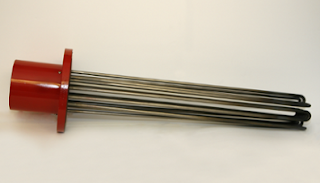
New Compact Heater for Clean Liquids and Gases

The BCE Mini Clean Flow Heater operates in a liquid or gas stream providing very fast response times and accurate control capability.

The heating elements in the Mini Clean Flow Heater are isolated electrically from the process media, protecting them from contaminants and providing long life.
  • Designed for heating of clean gases or liquids 
  • Gas flow passes over an enclosed heated body; not exposed to resistive elements (ni-chrome) 
  • All parts exposed to gas flow are constructed of 304 stainless (other material available) 
  • High temperatures 
  • Custom wattages, voltages, inlet and outlet fittings are available. 
  • Made in U.S.A.

Maintaining Close Temperature Control of a Fluid Process Flow

Temperature control is a common operation in the industrial arena. Its application can range across solids, liquids, and gases. The dynamics of a particular operation will influence the selection of instruments and equipment to meet the project requirements. In addition to general performance requirements, safety should always be a consideration in the design of a temperature control system involving enough energy to damage the system or create a hazardous condition.

Let's narrow the application range to non-flammable flowing fluids that require elevated temperatures. In the interest of clarity, this illustration is presented without any complicating factors that may be encountered in actual practice. Much of what is presented here, however, will apply universally to other scenarios.
What are the considerations for specifying the right equipment?


Know your flow. 

First and foremost, you must have complete understanding of certain characteristics of the fluid.
  • Specific Heat - The amount of heat input required to increase the temperature of a mass unit of the media by one degree.
  • Minimum Inlet Temperature - The lowest media temperature entering the process and requiring heating to a setpoint. Use the worst (coldest) case anticipated.
  • Mass Flow Rate - An element in the calculation for total heat requirement. If the flow rate will vary, use the maximum anticipated flow.
  • Maximum Required Outlet Temperature - Used with minimum inlet temperature in the calculation of the maximum heat input required.


Select system components with performance to match the project.

  • Heat Source - If temperature control with little deviation from a setpoint is your goal, electric heat will likely be your heating source of choice. It responds quickly to changes in a control signal and the output can be adjusted in very small increments to achieve a close balance between process heat requirement and actual heat input. 
  • Sensor - Sensor selection is critical to attaining close temperature control. There are many factors to consider, well beyond the scope of this article, but the ability of the sensor to rapidly detect small changes in media temperature is a key element of a successful project. Attention should be given to the sensor containment, or sheath, the mass of the materials surrounding the sensor that are part of the assembly, along with the accuracy of the sensor.

    The location of the temperature sensor will be a key factor in control system performance. The sensing element should be placed where it will be exposed to the genuine process condition, avoiding effects of recently heated fluid that may have not completely mixed with the balance of the media. Locate too close to the heater and there may be anomalies caused by the heater. A sensor installed too distant from the heater may respond too slowly. Remember that the heating assembly, in whatever form it may take, is a source of disturbance to the process. It is important to detect the impact of the disturbance as early and accurately as possible.
  • Controller - The controller should provide an output that is compatible with the heater power controller and have the capability to provide a continuously varying signal or one that can be very rapidly cycled. There are many other features that can be incorporated into the controller for alarms, display, and other useful functions. These have little bearing on the actual control of the process, but can provide useful information to the opeartor. 
  • Power Controller - A great advantage of electric heaters is their compatibility with very rapid cycling or other adjustments to their input power. A power controller that varies the total power to the heater in very small increments will allow for fine tuning the heat input to the process.
  • Performance Monitoring - Depending upon the critical nature of the heating activity to overall process performance, it may be useful to monitor not only the media temperature, but aspects of heater or controller performance that indicate the devices are working. Knowing something is not working sooner, rather than later, is generally beneficial. Controllers usually have some sort of sensor failure notification built in. Heater operation can be monitored my measurement of the circuit current. 


Safety Considerations

Any industrial heater assembly is capable of producing surface temperatures hot enough to cause trouble. Monitoring process and heater performance and operation, providing backup safety controls, is necessary to reduce the probability of damage or catastrophe.
  • High Fluid Temperature - An independent sensor can monitor process fluid temperature, with instrumentation providing an alert and limit controllers taking action if unexpected limits are reached.
  • Heater Temperature - Monitoring the heater sheath temperature can provide warning of a number of failure conditions, such as low fluid flow, no fluid present, or power controller failure. A proper response activity should be automatically executed when unsafe or unanticipated conditions occur.
  • Media Present - There are a number of ways to directly or indirectly determine whether media is present. The media, whether gaseous or liquid, is necessary to maintain an operational connection between the heater assembly and the sensor. 
  • Flow Present - Whether gaseous or liquid media, flow is necessary to keep most industrial heaters from burning out. Understand the limitations and operating requirements of the heating assembly employed and make sure those conditions are maintained. 
  • Heater Immersion - Heaters intended for immersion in liquid may have watt density ratings that will produce excessive or damaging element temperatures if operated in air. Strategic location of a temperature sensor may be sufficient to detect whether a portion of the heater assembly is operating in air. An automatic protective response should be provided in the control scheme for this condition.
Each of the items mentioned above is due careful consideration for an industrial fluid heating application. Your particular process will present its own set of specific challenges with respect to performance and safety. Share your requirements with process heat experts, combining your process knowledge with their expertise to develop safe and effective solutions.

Heaters for Process Air and Gases

electric heaters for process air or gas streams
Examples of process air heaters
Courtesy Hotwatt
Many process applications require heating of an air or gas stream. There is a wide variety of electric heating units specifically designed for processing flowing streams of air or non-flammable gas.

The primay selection criteria for a process air heating unit should be the heating capacity or wattage. Determine the maximum flow rate, inlet and outlet temperatures, then apply a simple formula from the document included below to find the minimum watt rating for a heating unit. Outlet temperatures can range to 1000°F (540°C) and flow rates to 200 scfm. Custom units can accommodate applications beyond those limits.

The outlet temperature can be controlled in a number of ways. One is to regulate the power applied to the heater. This would be applicable to a process that required a constant or minimum air flow rate. If the flow rate can be varied, another method of temperature control is available. Maintaining constant power to the heater and varying the air flow rate can serve as a means of controlling the output temperature.

Various connection sizes and fittings can be included in the heater assembly design to accommodate its incorporation into a process equipment train. Share your process heating requirements and challenges with experienced application engineers, combining your own process knowledge with their product application expertise to develop effective solutions.


Industrial Process Temperature Sensor Comparison

industrial thermocouples
Array of thermoucouple assemblies
Courtesy Durex
It's always useful to have quick references for things. Durex, a globally recognized manufacturer of electric heating solutions, published the Temperature Sensor Element Selection Guide included below in a recent blog posting. It provides a consolidated comparison of the four primary temperature sensing devices used for industrial process control. Many will find it useful, so we share it with you here.

All the technical expertise needed for your process heating challenges is readily accessible at BCE. Share your heating challenges with experts, combining your process and application knowledge with their expertise to develop effective solutions.


Flanged and Screw Plug Electric Heating Assemblies for Industrial Applications

flanged tubular electric heater assembly
Flanged Tubular Electric Heater Assembly
Hotwatt
Electric heating, though not the most energy efficient means of delivering heat, provides some distinct advantages as a means of controlling the temperature or thermal component of fluids and solids throughout commercial and industrial settings.

Tubular elements are a common form of electric heater. Essentially a metal tube with resistance wire and electrical insulation inside, tubular elements can be configured into almost uncountable shapes and sizes. Manufacturers typically offer a range of standard sizes and ratings, but that should never deter you from making contact to discuss your ideas for a custom arrangement.

Two mounting schemes that are readily used on tanks or other vessels are the screw plug and flanged heater assemblies. In each case, tubular heaters are bent in a "U" shape and fitted into either a pipe flange or a threaded plug. A junction box encloses the electrical terminations for the heating elements, providing a single ended assembly that can be easily mounted to an industrial standard mechanical connection. These assemblies are useful for tank or vessel OEMs that wish to provide a fluid heating option to their customers.
tubular electric heaters screw plug mounting
Examples of Screw Plug Electric Heaters
Hotwatt

Electric heat enables a properly configured controller to proportion heat into a subject fluid across a wide range, from very small packets that could be fractional percentages of full capacity to the fully available output of the heater. The units are compact, rugged, and can be configured to accommodate a broad array of industrial environments and applications.

Selecting or specifying a unit is uncomplicated. Determine the amount of heating capacity needed, then select the assembly mounting type (flange, screw plug, or other). Select an element sheath material that is compatible with the process media and a termination enclosure that suits the surrounding environment. Application assistance is available from product specialists who are well versed in the available options and can help you specify an assembly that provides excellent performance and an extended service life.

BCE Epoxy Vacuum Feedthroughs: When You Need to Pass a Signal Through A Vacuum Chamber Wall


Equipment manufacturers and scientific researchers are continually challenged with supplying power, fiber-optic, control, and monitoring cables into (and out of) sealed vacuum vessels. Whether due to space restrictions, special geometries, or number and type of conductors, standard glass-to-metal or ceramic feedthroughs never quite fit the bill. Unfortunately, because of limited options, many designers are forced to compromise and go for an off-the-shelf solution.

You don't have to compromise anymore.  EPOXY TO THE RESCUE. 

During the past decade, new epoxy compounds have been developed that rival glass and ceramic in performance. BCE is at the forefront of this development and leverages modern epoxy's unique properties to solve your feedthrough challenges.

With modern epoxy feedthroughs, any kind of standard or custom connector is sealed in a completely potted, high-performance, clear epoxy compound. Epoxy seals offer countless design options, and most amazingly, performance equal to or better than glass or ceramic. Better yet, pricing is very competitive and quick turn-around for prototypes and short production runs are not a problem.

BCE custom epoxy vacuum feedthroughs offer the best choice in application flexibility, cost, and high performance. Epoxy feedthroughs are the right product for today’s fast moving markets. If you have to pass an electrical, pneumatic, or fiber-optic signal through a vacuum chamber wall, THINK OF BCE!

New BCE Expoxy Vacuum Feedthrough Video

Check it out ....