- Temperature 650⁰C-700⁰C
- 18” Long cold pin section with CF Vacuum Flange on the bottom
- Helium Leak rate of 1 x 10̄¯9 cc/sec He on CF Flange only
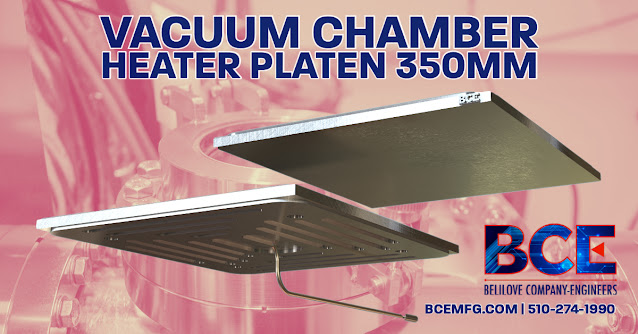
- 300mm x 350mm x 12.7mm thick for silicon and glass products
- Thermocouple built-in for over-temp protection or control
- 2,400 Watt (± 10%) , 240 Volt
- Mounting threads on the bottom of the assembly
- Material: 304 Stainless Steel
An instructional blog about specialized electric heating elements and vacuum feedthroughs for the OEM, analytical, semiconductor, aerospace, pharmaceutical, chemical, water, environmental, food processing, and alternative energy markets. Please feel free to contact us at (510) 274-1990 with any questions. BCEmfg.com
Vacuum Chamber Heater Platen 350mm
ALD Vacuum Chamber Pedestal Heater with Extended Sleeve
- Temperature 450⁰C
- 25” Long sleeve with 2.75 CF Flange on the bottom
- Body must pass Helium Leak rate of 1 x 10̄¯9 cc/sec He
- 6” overall diameter for 6” (152mm) wafers
- Top surface must have a flatness of ± .005”
- Thermocouple for additional temperature measurement
- 1,000 Watt (± 10%) , 120 Volt
- Material was 304 Stainless Steel
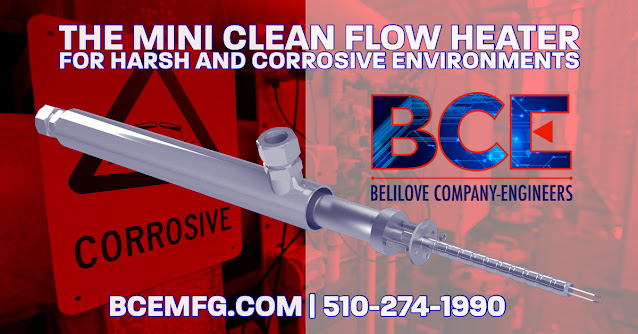
Mini Clean Flow Heater for Harsh Environments
- Temperature outlet needed to be 100⁰C
- Perpendicular configuration, with locking fittings
- Body must pass Helium Leak rate of 1 x 10⁻⁷ cc/sec He
- Pressure test of 50PSI
- Ability to place heater in a series flow configuration if necessary
- Thermocouple for additional temperature measurement
- 400 Watt, 120 Volt
- All wetted surfaces must be 304 or 316 Stainless Steel L (low carbon)
Experienced Electric Heating Element Designers Speed Development Time and Save Money in OEM Product Development
Technology advances rapidly, and findings in material science, medicine, pharmacology, biology, and semiconductors occur daily. These advancements in technology open the door for performance improvements leading to new treatments, medications, materials, and processes. Original equipment manufacturers (OEM's) of analytical, semiconductor, biomedical, life-science, and aerospace equipment continually design new equipment to apply and leverage these new discoveries.
Experienced custom electric heater designers provide many essential benefits throughout the product development cycle. For instance:
- Front-end, practical design review to optimize manufacturability.
- Timely prototype development.
- Strong alliances with vendors.
- Single source responsibility.
- Testing, calibration, and QC.
- Inventory management.
- Value-added assembly.
The heater manufacturer partner provides:
- Critical guidance in material selection.
- Power requirements under load.
- Temperature vs. time data.
- Watt density optimization.
- Packaging advice.
Their help provides high performance, precise fit, and extended heater life.
The pressure to produce new devices that offer greater efficiencies, compactness, and production is always present. Each item in the precedent design undergoes scrutiny and transitions to a contemporary fit, form, or function. New components are needed to meet the new design requirements. By choosing an experienced custom electric heating element design partner, the OEM gets the precision they need, plus scores of other benefits derived from the heater vendor's tacit knowledge and past experiences.
Happy Holidays from BCE!
Wishing you a happy holiday and a wonderful New Year.
Best wishes from everyone at BCE.
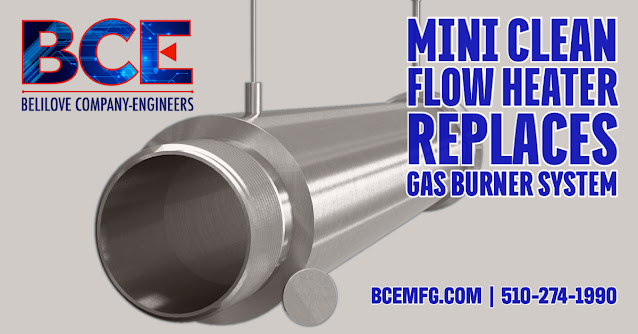
Environmentally Friendly Mini Clean Flow Heater Replaces Gas Burner System
The application involved using environmentally friendly electric heat replacing a gas burner type system. The engineering request was to conform to a direct replacement 3” stainless tubing while utilizing BCE’s Mini Clean Flow In-line design. The challenge was building the right inlet and outlet fittings in-line for a seamless change in the air heating process (gas to electric). Electrically isolated elements in the air stream were required with a high temperature thermocouple assembly near the outlet.
- Temperature 482°C to 648°C
- Internal element must be able to withstand temperature <750°C and be electrically isolated
- 3” outside diameter, no insulation
- A sanitary fitting on the inlet with an NPT on the outlet
- A cold section on the heat source was required with fiberglass leads
- 304 stainless steel material on the heat source and vessel
- Type “J” Thermocouple able to withstand high temp at the outlet
- 480Volt, 7,000Watt (+/-10%)
BCE produced a highly effective Mini Clean Flow heater meeting the delta “T” requirements during the final testing. We were able to pressure test the part to 90PSI @ 20⁰C-25⁰ without any visible leaks in the weld or braze joints. A thorough quality inspection was completed on the heater source with final cleaning using isopropyl alcohol and dry air.
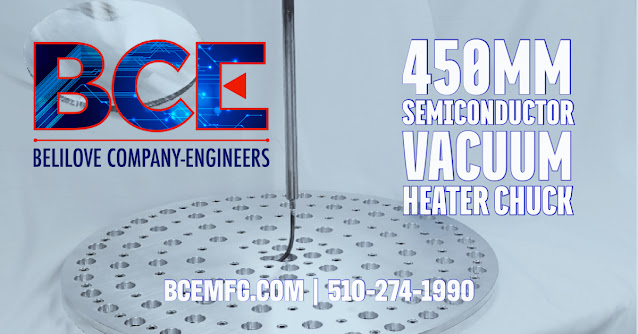
BCE Responds to Chip Shortage with 450mm Vacuum Heater Chuck Design
BACKGROUND
With the existing chip shortage, an atomic layer deposition (ALD) application up to 360⁰C was the focus of the latest BCE Vacuum Heater Chuck. A compressed assembly was used with many vacuum holes and grooves in the bottom plate to allow the gases to escape during pump down of the vacuum chamber. No surface anodizing was required.
SCOPE
450mm Vacuum Heater Chuck needed to satisfy the following: - Temperature <361°C
- Internal element must be able to withstand temperature <601°C
- Top surface 16ra
- A cold section was needed with added thickness for a vacuum fitting
- 304 Stainless Steel Heat Source
- 240Volt, 3850Watt (+/-10%)
- Type “K” Thermocouple was placed near edge (or built-in to heat source)
- Maximum allowable grooves and holes on the bottom plate to allow any trapped gases to escape
OUTCOME
BCE produced a highly effective vacuum heater which reached an atmospheric temperature of 360°C in under 30 minutes. The reduced mass on the bottom plate provided proper gas elimination with a quicker initial ramp time. Due to this decreased ramp time in atmosphere, a reduced wattage may be an option for the next iteration of the 450mm Vacuum Heater Chuck.