Epoxy-based Feedthroughs Provide Design Flexibility, Rapid Prototyping and Cost Savings

Multi-conductor, flanged feedthrough
Multi-conductor, flanged feedthrough.
The point of view that epoxy-based feedthroughs are inferior to glass-to-metal feedthroughs in terms of sealing and outgassing may have once been true, but modern manufacturing techniques and new epoxy compounds have all but eliminated those concerns. Modern epoxy formulations are more capable of enduring greater mechanical stresses, operating under wider temperature ranges, and sustaining exposure to harsher chemicals than ever before. Today's epoxy-based feedthroughs are excellent choices for even the most challenging feedthrough applications.

Take BCE's proprietary epoxy compound for instance. It seals to 1 X 10E-9 cc/sec of Helium under high vacuum and high pressure. Concerns of outgassing have been erased with the formulation meeting NASA’s ASTM E-595 low-outgassing specification, the industry standard test for measuring outgassing in adhesives and other materials. Developed to screen for low outgassing materials for use in deep space, the test determines the volatile content of material samples placed in a heated vacuum chamber under tightly controlled humidity, temperature, and vacuum conditions.

PCB feedthrough with clean epoxy feedthrough
PCB feedthrough with clear epoxy feedthrough.
Epoxy feedthroughs allow designers and engineers to procure a feedthrough built for the specific task, rather than to accommodate off-the-shelf connectors that are rarely ideal for the specific requirement. Off-the-shelf connectors and feedthroughs impose restrictions on the number and gauge of conductors, as well as the geometry of the device. The use of epoxy-based feedthroughs opens the door for virtually any combination of conductors, tubes, fiber optic cables, sizes and geometries.

It’s important to use the right feedthrough for a given application. Epoxy feedthroughs are not always the right choice, and consultation with an applications expert is always recommended.  But from the viewpoint of engineers and designers, epoxy-based feedthroughs usher in design freedom, prototyping, and cost advantages that once didn't exist. 

Clean Gas and Liquid Stream Heating

Clean gas and liquid heater
(BCE Mini Clean Flow)
As demand for purity increases throughout the medical, analytical, and semiconductor industries, equipment manufacturers continuously require new tools to reach the next technology threshold. In these industries electric heating applications for clean gases and liquids abound. Just a few examples are; clean air circulation, nitrogen heating, product drying, dehumidification, analytical instrument sample prep, incubation, DI water heating, solvent removal, wafer drying and processing.

High purity gas and liquid heating is challenging. Heater designs have to address problems and concerns involving contamination, thermal efficiency, electrical isolation, controllability, size, and packaging. Gas and liquid heating applications can vary dramatically. Some applications are very difficult to control and size is always a concern. One of the toughest issues to overcome is the seemingly mutually exclusive requirement for smaller size and higher power.
Clean gas and liquid heater
General diagram of "clean flow" heater.

Driven by innovation and competition, the need for hotter, cleaner, smaller and more efficient electric heaters is unceasing. One type of heater known as the "clean flow" has broad adaptability to many clean gas and liquid heating needs. It utilizes an internal heating element isolated from the process flow chamber, both electrically and physically. Best described as a "mini circulation heater", the heater's flow chamber, with inlet and outlet connections, completely protects the clean gas or liquid from external exposure and contamination.  The internal heating element can run at fairly high watt densities to accommodate fast changing flow rates, while still maintaining a compact and efficient package.  Internal RTDs or thermocouples can be incorporated to monitor temperature closely, or to protect the heater from over-temperature.

If you have questions about electrically heating clean gases or liquids, contact BCE by either visiting https://bcemfg.com or by calling (510) 274-1990.


BCE ISO 9001: 2015 Update

BCE is very pleased to announce the company has been awarded ISO 9001: 2015 approval.

July 23, 2018 - BCE, Inc., a California based designer and manufacturer of electric thermal systems and vacuum feedthrough devices, announced today that it has been recognized for its commitment to quality and excellence by being certified in accordance with ISO 9001:2015.

For more information, contact BCE by calling 510-274-1990 or visiting https://bcemfg.com.

The SMARTFLOW Circulation Heater - Highly Efficient Electric Heater Design for Heating Liquids

The SMARTFLOW liquid heater is designed for applications where fast heating of liquids is required. All parts exposed to liquid flow are constructed of 304/316SS (other materials available). All units have built-in Type J or K TC with potential of added adapter for outlet flow.


  • Wetted parts constructed of 316 stainless steel (other material available) 
  • Liquid flow passes over an enclosed heated body.
  • All threaded fittings are available as NPT, SAE, BSP & VCR
  • Internal heater provides uniform heating.
  • Made in U.S.A.

https://bcemfg.com
510-274-1990

Get Hot! with BCE's Mini Clean Flow Heater

A very compact, fast responding electric heating element for liquids and gases for all clean, fuel cell, bio-med, laboratory, food, and pharmaceutical applications.

The heating elements inside the Mini Clean Flow Heater are isolated electrically from the process media, protecting them from contaminants and providing long life.

The Mini Clean Flow Heater operates in a liquid or gas stream providing very fast response times and accurate control capability.


Epoxy Feedthroughs: Fast, Flexible, Affordable

During the past decade, new epoxy compounds have been developed that rival glass and ceramic in performance. BCE is at the forefront of this development.

With modern epoxy feedthroughs, any kind of standard or custom connector is sealed in a completely potted, high-performance, clear epoxy compound. Epoxy seals offer countless design options, and most amazingly, performance equal to or better than glass or ceramic. Better yet, pricing is very competitive and quick turn-around for prototypes and short production runs are not a problem.

FAST PROTOTYPES
BCE can provide custom prototypes for your design with high vacuum performance for today's fast moving markets.

PRINTED CIRCUIT BOARD, FLANGED OR THREADED CONNECTIONS
Wide variety of standard and custom mounting options for epoxy vacuum feedthroughs.

FEWER COMPONENTS, INCREASED RELIABILITY
Fewer components and connectors, often reducing 5 components to 1, BCE epoxy feedthroughs also eliminate multiple potential failure points.

CERTIFIED LOW OUTGASSING
BCE feedthroughs meet NASA outgassing requirements. BCE vacuum leak checks 100% of feedthroughs.

Electric Heating Element Design: Nichrome Wire

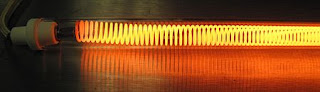
Nichrome wire heater element
Nichrome wire heating element inside a quartz tube.
(Image courtesy of Wikipedia)
When an electric current passes through a conductive material (a resistor) energy in the form of heat is released. The greater the resistance to electron flow, the greater the heat energy created. The terms resistance and conductance apply to the nature of the conductive material, and it's ability to pass current.

Resistance (measured in ohms and using symbol "R") is defined as the electrical voltage (in volts using symbols "V") divided by the current (in amps, using symbol "I"), or R=V/I. This formula is one variant of Ohm's Law.

The heat, or power, released from the resistor (measured in watts, using the symbol "P") is a function of the supply voltage squared, divided by the conductor resistance. This version of Ohm's Law looks like this: Watts = Voltage squared / Resistance, or P=V2/R.

You can see if the resistance is too high, voltage does not flow, and no heat is produced. For the benefit of simplicity, we'll forego a discussion into superconductors, like those used on MRI machines and mass spectrometers, because their behavior includes complicated magnetic field discussions. Instead, we'll stick to common conductors often used to pass electrical current.

Selecting the right resistive material for a heating element is crucial in order to maximize heat output, heater longevity and energy usage - a conductive material with high resistance that is also easy to work with.

Nichrome alloy, made up of 80% nickel and 20% chromium is by far the most popular resistance heater wire, and is a available in a wide variety of wire gauges and ribbon shapes. It's popularity is performance based - it has high resistance, is easy to apply to many heater configurations, does not oxidize, has a low expansion coefficient and a high melting point. In the design and development of electric heating elements, if you grant that nichrome wire is at the heart of most electric heaters, everything else comes down to packaging and performance.

While there are other materials such as Kanthal (iron / chromium / aluminum) and Cupronickel (copper / nickel), and newer exotic ceramics, the vast majority of electric heaters used in industrial, commercial, OEM, and consumer goods all still rely on the ubiquitous and time proven nichrome alloy.

For more information on electric heating elements, contact BCE by visiting https://bcemfg.com or by calling (510) 274-1990.