Showing posts with label HEM. Show all posts

HEM Sealed Heater™ - Bench Test to 250°C

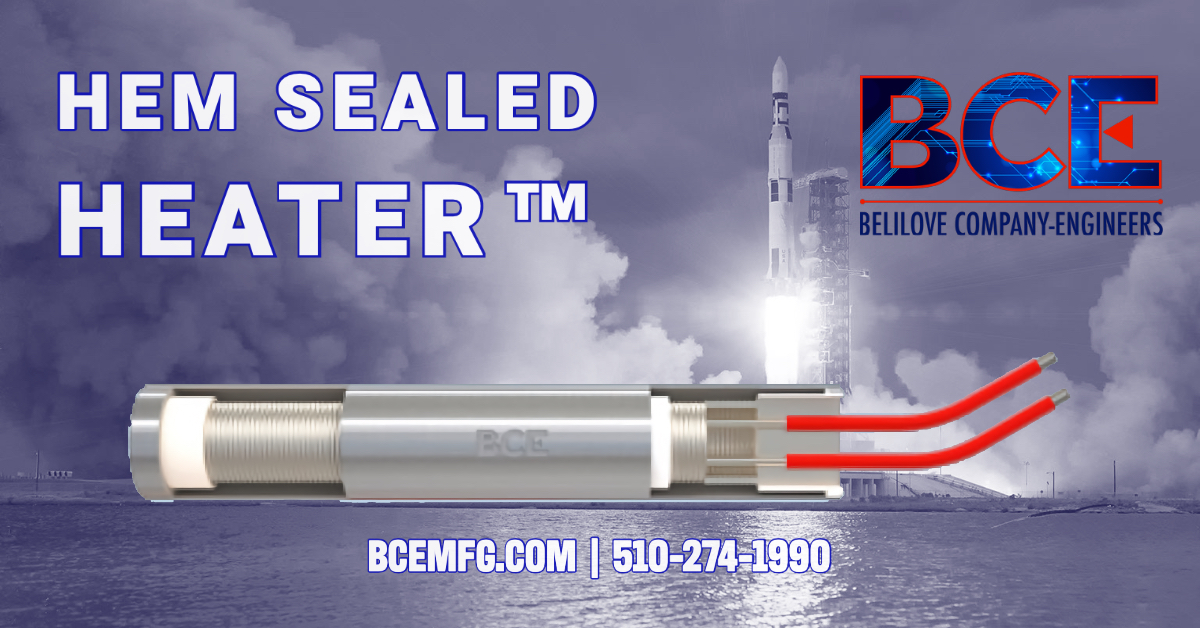
HEM Sealed Heater

In addition to optimizing liquid flow in space launches, more research and design facilities require a heater that will work in vacuum without outgassing the internal resistor and insulating materials.  Materials such as chromium and particles from the magnesium oxide begin to outgas.  Placing a vacuum barrier that keeps these particles in place and allows the operator to process without consistently replacing heaters, should increase productivity.

HEM Sealed Heater™/ Vacuum Chambers:
  • Temperature range of -55⁰C to +200⁰C Sheath Temperatures
  • Stainless steel 321 for heated zone, 304 Hem Sealed Cap   
  • 18AWG to 32AWG Kapton®/polyimide Lead wires 
  • 500Watt (± 10%) , 240 Volt, 1-phase   
  • He Leak Tested = 5 x 10¯⁹ ATM, CC/sec or better 
  • Hi-Pot Test 1K*2E 1 2 seconds (1500-2250VDC 0.5mA) 
  • Meg-Ohm 20 to 4,000+ @ 500VDC 

OUTCOME:

This test was performed in atmosphere within a 3.5 hour time frame.  The temperature was held each hour after the initial ramp to sheath temperature as noted in the graph below.

The temperature of 200°C was held for the 2nd hour and then the heater was powered ~250°C and held until the test was complete after about 3.5 hours.  

At lower temperatures of ~200°C, the Hem Sealed™ Cap reached 60°C keeping the vacuum integrity as per the maximum heater transition temp of 70°C.  The maximum temperature on the sheath tested was to 250°C with the Hem Sealed™ Cap at 79°C.

Special note; if a heater block or other device being heated, the optimal bore diameter vs heater diameter for the best heat transfer should be +.0020” to +.0025”.


BCE

+1 510-274-1990

Improved Electric Heating Element Design Optimizes Rocket Engine Propellant Flow

BCE HEM Sealed Heater

You might think a rocket engine would give off enough heat to keep any part of the engine warm, but as it turns out, that's not the case. In many instances, the high flow of very cold propellants can cause obstructions in the propellant manifolds and valves. The need for localized heat becomes essential, and is normally provided by exterior, surface mounted, flexible resistive heating elements. The most common type of electric heater used in these applications are thin polyimide patches bonded directly to the valves and manifolds. While this approach may be convenient in terms of shape and mounting, that advantage is significantly reduced when you consider what you lose in heater efficiency and
heat uniformity.

BCE, a California based manufacturer of electric heating elements, has developed a better approach. Their BCE HEM Sealed Heater™ is designed to be inserted directly in the heated bodies, maximizing the heat transfer and heat uniformity. The HEM Sealed Heater™ is secured directly to components by the means of an integrated flange. In essence, the BCE HEM Sealed Heater™ incorporates both the cartridge heaters’ wire wound resistive element encased in a metal sheath and the vacuum compatibility of a feedthrough. Furthermore, the BCE proprietary epoxy seal allows the heater to pass strict electrical tests ensuring the purity of the dielectric materials and hence, preventing shorting.

Learn more about the HEM Sealed Heater™here.


BCE
https://bcemfg.com
510-274-1990