Showing posts with label semiconductor. Show all posts

BCE Hi Temperature Puck Heater - 200mm

BCE Hi Temperature Puck Heater - 200mm

Background:

Industrial & semiconductor applications require high heat in a centralized location. BCE designed a heater platen with the goal of 900⁰C operation, fast ramp & soak of at least 800⁰C. When tested in our BCE Lab in Hayward California, we were able to push this heater further and achieved upwards of 1,050°C

Ramp Time:
  • Test#1 23°C to 800°C, 29 Min. (without Insulation)
  • Test#2 23°C to 800°C, 13 Min. (with 2" Insulation)
  • Test#3 23°C to 900°C, 17 Min. (with 2” Insulation)
  • Test#4 23°C to 950°C, 18 Min. (with 2” Insulation)
  • Test#5 23°C to 1,000°C,19 Min. (with 2” Insulation)

Temp. Uniformity:

After the heater stabilized from 800⁰C to 950⁰C, the surface thermocouple on the edge to the internal thermocouple (approximately 180⁰ away), there was a 1% to 2% delta.

Scope:
  • Material: 304 Stainless Steel with Inconel Heat Source
  • Stainless Steel CF or KF flanges of various sizes, with heat sink near heater outlet
  • 200mm Ø x 0.50” Thick
  • Vacuum, He Leak Test available
  • 700VDC, Hi-pot, 1mA current leakage
  • 5mΩ @ 500VDC prior to shipping

Outcome:

Ramped heater from 23°C to 1,000°C in 19 min. under 2” thick ceramic fiber insulation. The heater was held at this temperature for 1 hour, and it intermittently hit 1,050°C.

This video shows a test in atmosphere with no insulation which is less efficient but more interesting to look at.

BCE does not recommend operation above 900C as this can drastically impact the life of the assembly. Furthermore, high-temperature operations should be in a vacuum/oxygen-free environment, and use of insulation is advised.

BCE Mfg.
21060 Corsair Blvd. Hayward, CA 94545
510-274-1990

The BCE Hi-Temp Puck Heater


Introducing the Hi-Temp Puck Heater

The demand for high temperature applications in various industries such as vacuum chambers, laboratories, green energy, and 3D printing has led to the development of the innovative Hi-Temp Puck Heater. Designed to deliver exceptional performance and precision, this compact heating solution is capable of reaching temperatures up to an impressive 1,000°C, with intermittent temperatures exceeding 1,100°C.

BCE Hi-Temp Puck Heater

Unmatched Performance and Reliability

One of the key highlights of the Hi-Temp Puck Heater is its remarkable temperature range, spanning from 50°C to +1,000°C, making it suitable for a wide range of industrial applications. Whether you need consistent high heat or intermittent bursts of extreme temperature, this heater has got you covered with a built-in thermocouple for precise temperature control.   

Constructed with high-grade stainless steel, the Hi-Temp Puck Heater ensures durability and longevity. Its compact design, measuring just 2.5" in diameter and 0.56" thick, allows for easy integration into existing systems without compromising space or efficiency.

Versatile Flange Options

To accommodate different setups and requirements, the Hi-Temp Puck Heater offers stainless steel CF or KF flanges in various sizes. This versatility ensures seamless compatibility with a range of vacuum chambers and other industrial equipment.

Reliable Testing and Certification

Prior to shipping, each Hi-Temp Puck Heater undergoes rigorous testing to ensure quality and reliability. The heaters are subjected to vacuum and helium leak tests, guaranteeing their suitability for high-pressure and demanding environments. Furthermore, the units undergo a 700VDC hi-pot test with a 1mA current leakage inspection to ensure electrical safety. With a resistance of 5mΩ at 500VDC, these heaters are built to perform consistently and reliably.

Unprecedented Heating Performance

In a recent application conducted at our BCE Lab in Hayward, California, we put the Hi-Temp Puck Heater to the test. The customer's specific requirements called for rapid heating and temperature stability. To exceed expectations, we pushed the heater to its limits, achieving an impressive ramp-up from 27°C to 1,000°C in just 15 minutes. This remarkable heating capability was facilitated by a 1" thick ceramic fiber insulation, ensuring optimal heat retention. Even more impressive, the heater maintained a steady temperature of 1,000°C for a duration of one hour, with intermittent temp to 1,100°C. You can witness the exceptional performance of the Hi-Temp Puck Heater in action by watching the video below.

https://bcemfg.com
510-274-1990

The Critical Role Vacuum Feedthroughs Play in Industry

The Critical Role Vacuum Feedthroughs Play in Industry

Vacuum feedthroughs are vital in various industries that require maintaining a vacuum environment while transferring materials, data, or energy through the vacuum barrier. Key industries include:


  1. Semiconductor Manufacturing: Vacuum feedthroughs are essential for maintaining a controlled environment while producing integrated circuits, photovoltaic cells, and other semiconductor devices.
  2. Aerospace and Space Research: Vacuum feedthroughs are used in space simulation chambers, vacuum testing of spacecraft components, and satellite testing, ensuring the integrity of the vacuum environment and enabling data and power transmission.
  3. Pharmaceutical and Biotechnology: Vacuum feedthroughs are used in vacuum-based processes such as lyophilization (freeze-drying), vacuum distillation, and sterilization, ensuring the transfer of materials and data without compromising the vacuum environment.
  4. High-Energy Physics Research: Vacuum feedthroughs are crucial in particle accelerators, such as the Large Hadron Collider (LHC), where they allow the transfer of electrical signals, cooling fluids, and other materials while maintaining a high-vacuum environment.
  5. Thin Film Deposition and Surface Science: Vacuum feedthroughs are used in vacuum-based processes like physical vapor deposition (PVD), chemical vapor deposition (CVD), and sputtering to ensure the transfer of materials, data, and power without affecting the vacuum.
  6. Materials Science: Vacuum feedthroughs are used in various material processing techniques, such as vacuum annealing, vacuum brazing, and vacuum sintering.
  7. Electronics and Optoelectronics: Vacuum feedthroughs are essential for maintaining a vacuum environment during the manufacturing and testing various electronic and optoelectronic components, including vacuum tubes, sensors, and detectors.
  8. Nuclear Research and Fusion: Vacuum feedthroughs are used in nuclear research facilities and fusion reactors to transfer data, power, and materials while maintaining a vacuum environment.


These are just a few examples of industries where vacuum feedthroughs play a crucial role, but there are also many other applications. BCE specializes in crafting premium vacuum feedthroughs tailored to various applications and industries. Our expert engineers bring decades of design and development know-how, amassing an invaluable empirical data and insights repository. At BCE, we are eager to accommodate your unique feedthrough needs, ensuring that our custom-designed solutions effectively address your most demanding challenges.


BCE

+1 510-274-1990

ALD Vacuum Chamber Pedestal Heater with Extended Sleeve

ALD Vacuum Chamber Pedestal Heater with Extended Sleeve

BACKGROUND
Heating solution for an ALD Vacuum Chamber Heater testing 6” (152mm) wafers up to 450⁰C.  There were obvious space constraints at the customer site requiring an extended sleeve of 25”.  The extra-long length enabled the placement of the wafer on the top surface eliminating the need to modify the existing chamber.  

SCOPE
The Vacuum Pedestal Heater needed to satisfy the following:
  • Temperature 450⁰C  
  • 25” Long sleeve with 2.75 CF Flange on the bottom 
  • Body must pass Helium Leak rate of 1 x 10̄¯9 cc/sec He 
  • 6” overall diameter for 6” (152mm) wafers
  • Top surface must have a flatness of  ± .005” 
  • Thermocouple for additional temperature measurement
  • 1,000  Watt (± 10%) , 120 Volt
  • Material was 304 Stainless Steel
OUTCOME
The Vacuum Pedestal Heater was ramped in atmosphere to 450⁰C in approximately 45 minutes.  Due to the 360⁰ weld, there was some deflection on the top surface causing it to be out of tolerance.  After the 450⁰C ramp, the Vacuum Pedestal Heater was polished down to below ± .005”.  A leak test was performed to spec and cleaned to high purity standards then shipped in clean room bags.

HK 300mm Compressed Heater Chuck

HK 300mm Compressed Heater Chuck

 BACKGROUND

To reduce the overall cost for an existing application, BCE developed a 300mm aluminum heater chuck that is un-brazed utilizing the compression of two plates with countersink set screws. The heater surface specs were 0.003” flatness at a 0.005” parallelism. Using a 208-volt power supply at 9.7ohm, start @ 25°C temperature and ramped from 100°C to 465°C in 23 minutes. 

SCOPE

Aluminum Heater Chuck needed to satisfy the following:

  • Achieve temperature up to 435°C  @ +/- 2% or better 
  • Internal element must be able to withstand temperatures up to 600°C
  • Anodized surface for electrical isolation 
  • 208 Volt, 9.7 Ohm, 4,460 Watt (+5% / - 10%) 
  • Thermocouple bore hole to be placed at the center (variable) 
  • 4 point temperature profile on the top surface of the heater 
  • Used an infrared sensor for each 4 point locations
  • FINISH: Hard coat anodize per MIL-A-8625F, Type 3 Class1 Hard-coat thickness  

OUTCOME

BCE produced a highly effective high 300mm heater with exceptional uniformity better than the proposed 435°C (+/-2%).  After the initial ramp, the heater maintained 435°C (+/- 1%) as per the chart below (Temp profile #5). 

300mm heater chuck
BCE
510-274-1990

New Epoxy Compounds Give Researchers and OEM's Design Freedom in Specifying Vacuum Feedthroughs

OEM feedthrough
OEMs can no get a feedthrough to fit their design criteria.
Scientists and researchers are constantly challenged to come up with better ways to read data in a vacuum environment. Traditional ceramic and glass-to-metal vacuum feedthroughs do not offer design flexibility. Unique control and data signals must pass through the wall. In addition to passing electrical power and control signals, fiber optic cables and pneumatic tubing may be included. Always changing variables, such as the number and types of connectors, unique geometries, and limited available space, make finding an off-the-shelf feedthrough difficult. This has traditionally forced designers to compromise and specify a feedthrough with some, but not all, of the desired specifications. 

epoxy feedthrough
Clear epoxy feedthrough with ribbon connector.
This reality has led to significant development gains in custom epoxy feedthrough. Epoxy feedthroughs overcome design constraints. New epoxy properties rivaling ceramic and glass performance have been developed. High performance, clear epoxy potting opens the door for researchers to specify the exact number and type of wires, optical fiber cables, or any other insert that they require. Epoxy feedthrough manufacturers can provide a virtually limitless variety of wires, cables, or tubes along with the added benefit of fast prototyping and small production runs — perfect for the research and manufacturing community. 

Flanged feedthrough
Flanged feedthrough with epoxy potted fiber optic cable.
With the development of custom epoxy feedthroughs medical device companies, analyzer manufacturers, laboratories, aerospace companies and other R&D facilities can design their equipment based on optimum size, cost and performance, and not be forced to compromise by the limitations of ceramic and glass-to-metal feedthrough. Because of the constant pressure on "better, faster, smaller" vacuum equipment researchers and OEM designers, it's clear that epoxy feedthroughs provide flexibility and options for more efficient and creative design.

For information on epoxy vacuum feedthroughs, contact: 

BCE
(510) 274-1990

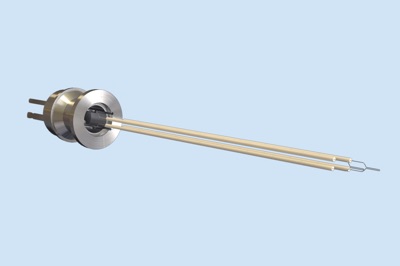
Twin Type-C Thermocouple, High Temperature, High Vacuum Feedthrough

Twin Type-C Thermocouple FeedthroughBACKGROUND

An application was presented to BCE in the semiconductor equipment industry for a high temperature, high vacuum thermocouple (TC). There was space limitation with a requirement for a multi-point TC to sense a very small insertion dimension. The TC probe area must be able to bend to allow the sensor tip to penetrate the temperature sensing zone. The BCE engineers and technicians were ready for the challenge with their experience in ceramic-to-metal sealing and high temp sensors.

SCOPE
  • Twin Type-C Thermocouple Vacuum Feedthrough needed to satisfy the following criteria:
  • <1425°C continuous operating temperature in probe area
  • Two independent type “C” thermocouple probes
  • KF16 Flange
  • Vacuum rating: 10 9̄ ATM-CC/Sec
  • Feedthrough Seal Temp: -25°C to 300°C
  • Probe section needs to be bendable and vacuum compatible with SEMI standard
  • ALL TESTS PERFORMED AT ROOM TEMPERATURE
OUTCOME

BCE designed an effective High Temperature Vacuum TC that was delivered for prototyping and customer testing. The application requirement was met and the function was sound. All tests performed prior to shipping were completed at BCE. A standard operating procedure (SOP) was finished and the part is production ready.

More information on this BCE product can be found at this link. 

BCE
https://bcemfg.com
510-274-1990

Electric In-line Clean Fluid Heater Provides On-demand Heat in a Small Package

clean fluid, flow-through heater
Clean fluid, flow-through heating system.
Many original equipment manufacturers require precise temperature control and a very compact package to heat clean fluids. Equipment examples are semiconductor gas processing equipment, kidney dialysis (hemodialysis) machines, process gas analyzers, ink preheating systems, photoresist coating equipment, and parts cleaning equipment.

Electric heaters used in these applications must be compact, lightweight, and made of materials that won't contaminate samples. They also must be fast responding and provide large amounts of power when required.

BCE, a Northern California manufacturer of custom electric heating elements, developed their "Mini Clean Flow" heater for these types of applications. The Mini Clean Flow is a very compact, fast responding electric heating element designed for applications where the heating of clean fluids is required, most often in the semiconductor, medical, and laboratory equipment industries. Designed with high power ratings wrapped in a small package, these specialized heaters offer ultra-fast heat-up and precise, accurate temperature control.

Mini Clean Flow heaters combine inlet and outlet connections along with a baffled stainless steel enclosure, creating a turbulent flow pattern for efficient heat transfer. Sealed resistance heaters are used to isolate process fluids from having contact with the elements directly. Internal thermocouples provide for outlet temperature regulation as well as for maximum sheath temperature control.  The Mini Clean Flow's advanced mechanical design, along with its high power density and overall low mass, provides the end-user with a very efficient and precise heating solution.

For more information, contact BCE.
Phone: 510-274-1990
Web: https://bcemfg.com/minicleanflow


BCE’s Vacuum Ring Heater: Defying Boundaries in Degassing Chambers

BCE Vacuum Ring Heater

Providing uniform heat to semiconductor devices in degassing chambers is essential in extracting impurities. This can only be achieved if a heating device has the proper fit and temperature uniformity for a given chamber. It is for this very application that BCE was approached by a large semiconductor company from Silicon Valley. In order to heat this company’s semiconductor wafers, it was critical that the heating device be manufactured to fit precisely into a large and circular degassing chamber posing manufacturing challenges due to dimensional and application parameters. BCE was able to provide extensive design consultations, 3D CAD modeling and lean manufacturing capabilities to this semiconductor giant at a competitive price. All these services were rendered while catering to all requirements needed to successfully manufacture their products.

SCOPE


The heating apparatus needed to satisfy the following criteria:
  • Vacuum compatibility to 10-8 Torr 
  • Maximum Operating Temperature: 200°C 
  • Temperature uniformity of ±4% at 150°C 
  • Operate at 1500W, 240V 
  • All epoxies used needed to meet NASA’s Low Outgassing Spec (ASTM E595) 
  • Reduced contamination from components inside chamber 
  • Temperature sensing capability 
  • Circular configuration between 34 and 36 inches in diameter 
  • Height of part was not to exceed 1 ft. 
  • Effective heat transfer from heating device with reduced machining cost 
OUTCOME

BCE’s Vacuum Ring Heater proved to be the ideal product for this application. Its strong aluminum ring construction ensured effective heat transfer to the circular wafers while keeping manufacturing costs low. Furthermore, its strategically embedded heater with stainless steel sheath allowed the device’s temperature uniformity to remain at ±2% at 150°C, greatly exceeding customer requirements. Moreover, BCE’s proprietary epoxy meeting NASA’s low outgassing spec was used as the primary sealant and KAPTON insulated leads were provided for the heater and integrated thermocouple to reduce contamination. In fact, the integrated thermocouple type K further served to monitor the temperature supplied to the chamber. Finally, all electrical, vacuum and dimensional requirements were met to provide the most optimal thermal environment.

Visit this link for more information on the Vacuum Ring Heater, or call (510) 274-1990.

9 Pin Vacuum Feedthrough: UHV Compatible Technology Serving the Semiconductor Industry

Some of the most stringent tolerances and vacuum requirements exist in the ever-expanding semiconductor industry. Tight restrictions in vacuum ports, high temperature applications and exposure to high stress environments further add to the challenge of designing an electrical feedthrough that can be manufactured quickly and installed with ease. An American multinational manufacturer of chips and microprocessors approached BCE with these exact requirements in order to replace their existing vacuum feedthroughs incapable of providing an adequate performance in ultra-high vacuum environments. Furthermore, their existing supplier had long lead times and the procured feedthroughs needed to be replaced often as their contacts would fail due to oxidation formation on the conductive layer.

SCOPE
  • The feedthrough needed to satisfy the following requirements: 
  • Ultra-High Vacuum (UHV) compatibility up to 1 X 10⁻¹⁰ atm.cc/sec 
  • Remain operable at temperatures exceeding 250°C 
  • Pins preventing oxidation of conductive layer for longevity 
  • 9 pin feedthrough configuration 
  • Voltage requirement: 750 AC RMS 
  • Current requirement: 7 AMPS 
  • Quick-turnaround on feedthrough manufacturing 
  • Robust seal withstanding high stress environments 
  • Ease in installation, simple design 
  • Low cost for application 
OUTCOME

All customer requirements were exceeded by BCE’s 9 pin vacuum feedthrough. Not only did it meet all electrical and configuration specifications, it provided a vacuum compatibility twice as much as that required by the customer allowing them to expand their capabilities to higher vacuum thresholds. It also remained operable at higher temperatures, nearing maximums of 300°C. Furthermore, the gold plated pins proved to be ideal in the prevention of oxidative layers inhibiting current flow. Moreover, BCE’s proprietary ceramic seal achieved the desired robustness and allowed the feedthrough to remain operable under high stress conditions. Finally, the client was equally impressed by BCE’s quick-turnaround time and competitive pricing.

9 Pin Vacuum Feedthrough

Nine pin circular feedthroughs (often called instrumentation feedthroughs) are commonly used for the transmission of low power electrical signals. They are designed for applications where typical Subminiature Type-D connections will not fit, or where there is little space. The circular geometry allows the installation of this feedthrough into very small vacuum flanges. They are often used in instrumentation applications such as semiconductor processing, electron microscopy, and a variety of analyzers.

Nine Berrylium-Copper alloy contacts, Gold plated per ASTM B488-01, are sealed and electrically insulated in a 304 stainless steel shell using the latest in ceramic bonding technology. Multiple contact configurations are available.

Specifications:
  • Leak Rate: 2X10 - 10  CC/Sec HE At One Atmosphere
  • Laser Welded Assembly
  • Hermetic Ceramic Seal for Contacts
  • Temperature Rating: -65°C To 300°C
  • Voltage: 750 AC RMS
  • Current: 7 Amps
  • Compact, Fits Easily into Complex Assemblies
  • Adapts to Different Signals
  • Mating UHV Connectors and Cables Available
For more information, visit http://www.belilove.com/feedthrough.

Engineered Ceramics for the Analytical, Semiconductor, Electronics, Defense, Medical, and Aerospace Industries

advanced ceramics machining
Advanced ceramics machining
Ceramics are inorganic, non-metallic materials made from compounds of a metal and a non-metal. They include such compounds as oxides, nitrides, and carbides. Ceramics are typically insulators (electrically and thermally), but their properties can vary widely - for instance some ceramics actually belong to the super-conductor class. Advanced ceramics, such as alumina, zirconia, silicone carbide and silicone nitride are very resistant to corrosive chemicals and high temperatures. They posses higher stiffness and lower fracture toughness than metals.

Ceramics behavior under mechanical, thermal and chemical stress differs widely from other materials such as metals, which makes machining ceramics very difficult and requires knowledge, experience, equipment, and expertise. As the need for higher performance / higher precision parts has increased, advances in ceramics machining has overcome many of yesterdays machining challenges, and today's high-tech processes are yielding extremely close tolerance parts and ultra precise shapes.

Ceramic machining is the process of shaping the advanced ceramic material into high precision parts used in industry. Machining removes unwanted material by mechanical means, using very hard abrasive particles. If the machining is done before sintering (to achieve a "near-net-shape" to save time and money), the ceramic is referred to as in the "green state". Green state machining offers considerable advantages in quality, lower production costs, and manufacturing flexibility.

Grinding, the material removal process where abrasives is used, is the most prevalent machining process for advanced ceramics. Polycrystalline diamond and cubic boron nitride are the grinding materials of choice because of their hardness. Their particles are fixed to a grinding tool (or wheel) via resin or vitreous bonding, and are turned against the ceramic part at high speeds. Variation in grinding efficiency is a challenge though, due to the constant changing state of the grinding tools because of wear and abrasion.

The following chart is a helpful reference guide to the properties of some common advanced ceramics (click on chart for larger view).
For any inquiry on precision machined ceramics or thick film ceramic heaters, contact BCE at:

21060 Corsair Blvd
Hayward, CA 94545
Phone: (510) 274-1990
Fax: (510) 274-1999
www.belilove.com
E-mail: sales@belilove.com

Custom Heating Elements and Controls

custom heating element
Custom heating element.
Many types of industrial and manufacturing equipment, including analytical instrumentation, semiconductor, photovoltaic, medical, plastics processing, foodservice packaging, and aerospace equipment require some kind of custom electric heater, controller, and sensor.

For instance here, in semiconductor processing, you can find a need for electric heating in all these areas:  Bake platen heaters, bake/chill pedestal & platen heaters, hot chuck heaters, high temperature platen heaters, standard pedestal heaters, vacuum chamber heaters, and aluminum pedestal heaters.

A well engineered thermal system considers overall heat load, maintenance power requirements, control method, and sensor location. Working with a vendor who has the experience and background in this kind of product development is critical. Careful consideration of form, fit, and function requires the guidance an experienced applications engineer to avoid wasted time and money. 


Custom Epoxy Vacuum Feedthroughs

THE NEED
Equipment manufacturers and scientific researchers are continually challenged with supplying power, fiber-optic, control, and monitoring cables through sealed vacuum vessels. Whether due to space restrictions, special geometries, or number and type of conductors, standard glass-to-metal or ceramic feedthroughs never quite fit the bill. Unfortunately, because of limited options, many designers are forced to compromise and go for an off-the-shelf solution.

THE SOLUTION
During the past decade, new epoxy compounds have been developed that rival glass and ceramic in performance. With modern epoxy feedthroughs, any kind of standard or custom connector is sealed in a completely potted, high-performance, clear epoxy compound. Epoxy seals offer countless design options, and most amazingly, performance equal to or better than glass or ceramic. Better yet, pricing is very competitive and quick turn-around for prototypes and short production runs are not a problem.

Custom Epoxy Vacuum Feed Throughs Take It All Through The Wall

custom epoxy feedthrough
Take it all through the wall!
Equipment manufacturers and scientific researchers are continually challenged with supplying power, fiber-optic, control, and monitoring cables into (and out of) sealed vacuum vessels. Whether due to space restrictions, special geometries, or number and type of conductors, standard glass-to-metal or ceramic feedthroughs never quite fit the bill. Unfortunately, because of limited options, many designers are forced to compromise and go for an off-the-shelf solution.

Epoxy to the rescue. During the past decade, new epoxy compounds have been developed that rival glass and ceramic in performance. BCE is at the forefront of this development and leverages modern epoxy's unique properties to solve your feedthrough challenges.


For more information visit www.belilove.com/feedthrough.

Epoxy Electrical Feedthroughs: A Better Choice

Epoxy Electrical Feedthrough
One thing is for sure. You don’t want to scrap a $125,000 semiconductor wafer because dust or a contaminant gas exploited your process through a faulty electrical feedthrough.  In vacuum or pressurized conditions, getting process control signals and power to and from the work environment is always a challenge. Continually evolving specifications of vacuum requirements, or pressurized manufacturing conditions, push the design limits of electrical feedthroughs.  Failure of the feedthrough is not an option.

In applications requiring ultra-clean environments, feedthroughs are always a concern.  Historically, the product-of-choice for semiconductor manufacturing applications was glass-to-metal or ceramic seals. While providing an excellent seal, they are quite limited by geometry, size, electrical shielding, and fragility. Compounding these limitations, manufacturing requirements continue to evolve making it necessary to deliver more data, provide greater signal shielding, and provide higher power. With glass-to-metal and ceramic seals, this becomes very difficult, expensive, and many times, near impossible.

Enter epoxy feedthroughs. The epoxy materials available today make it fairly easy to design feedthroughs with curves and angles well beyond the capability of glass and ceramic. Epoxy feedthroughs can be applied in many shapes and sizes, provides an excellent seal, and accommodates shielded cable quite nicely.

In terms of cost, versatility, and availability, epoxy feedthroughs have a huge advantage. With manufacturing requirements pushing for smaller and more compact equipment, design versatility of the feedthrough is very important, and something that glass-to-metal feedthroughs can not match. Equipment design conditions often require special geometries of the connector, and using epoxy as the filler makes perfect sense.

Another outstanding advantage to epoxy electrical feedthroughs are in availability. Small production runs are easily and quickly accommodated for testing and proof-of-concept.

Ancillary cost savings of epoxy feedthroughs can be evaluated on design accommodation / size reduction, and on the ability to provide cable harnesses right up to the seal, which dramatically lowers production cost. Time consuming manufacturing processes, such as soldering connectors, is eliminated.

For the most part, epoxy electrical feedthroughs can fit the bill as a better alternative to glass-to-metal or ceramic feedthroughs. Very few exceptions exist, and usually center around concern of the organics in epoxy, but again, these issues are very limited.

For more information contact BCE.

Choose the Best Type of Vacuum Feedthrough for Your Application

Vacuum Feedthroughs
An electrical vacuum feedthrough (sometimes spelled "vacuum feedthru") is used to transfer electrical signals,  currents, or voltages into a vacuum. Because of the wide variety of feedthroughs, there are numerous categories available to meet the various needs provided by vacuum feedthroughs.

Multi-pin feedthroughs have circular threaded connectors for moderate pin density. They are typically offered with differing numbers of pins (often, 3, 5 or 7) and rated to 3.5 amps and 500 volts per pin. There are both single-ended and double-ended versions which offer a connector for the air side or both air and vacuum side connectors respectively.

Vacuum Feedthroughs
Epoxy Vacuum Feedthrough
custom manufactured by BCE
A thermocouple feedthrough is an electrical vacuum feedthrough commonly used for systems involved in temperature measurement. The thermocouple feedthrough itself doesn’t measure temperature, but is used to conduct the voltage signal from the vacuum to an external device. These are suitable for use in ultra-high vacuum applications. 

Power electrical feedthroughs transmit high current and/or high voltage into a vacuum system. Variations of power electrical feedthroughs offer a range of current and voltage.

Epoxy vacuum feedthroughs offer the best application flexibility, they are cost competitive, and they have a high vacuum performance for today’s fast moving markets. Clear epoxy feedthroughs allow for the visual inspection of your components. They are board mountable with high vacuum performance and very competitive pricing compared to ceramic and metal seals.

Many accessories are available to be used in conjunction with the wide variety of vacuum feedthroughs. These included vacuum connectors, connectors, insulated wire, cable assemblies, insulators, and spacers, just to name a few.

Specialized feedthroughs may be needed if your application includes cryogenic or very low temperatures, high temperatures, aggressive chemicals, or high pressure. Contact an experienced manufacturer who specializes in vacuum feedthroughs to discuss which feedthrough will best meet your needs. A company worth their salt should be able to discern which would be the best fit with minimal hassle.

Visit this link for more information on electrical vacuum feedthroughs.


When You Need a Custom Heating Element or Thermal System Design

OEMs often need custom designed heating elements for their equipment. Designing an electric heating element, or a complete thermal system, requires both electrical and mechanical engineering skills. Often, you can save time and money by calling in an expert with the proper experience to assist.

Belilove Company-Engineers has decades of experience developing custom thermal solutions in many industries - from low tech to cutting-edge high tech, from foodservice appliances to semiconductor processing equipment, Belilove has "been there, done that". So the next time you need an electric heating element, temperature sensor, or controller, Think Belilove.


Advantages of Epoxy Electrical Feedthroughs Over Glass-to-Metal and Ceramic Seals

epoxy vacuum feedthrough
Epoxy Electrical
Vacuum Feedthrough
Advances in semiconductor and medical device development has continually challenged manufacturing processes in ultra-clean environments. Getting power and control signals into high vacuum chambers has always been difficult. The vacuum seal has to be tight and not allow any contamination so that product quality is maintained.

Historically glass-to-metal seals for wire feedthroughs have been the choice in these industries, but are constrained in size, geometry, flexibility and electro-magnetic shielding. At the same time, semiconductor and medical device equipment have an increasing need for higher power, more control, better monitoring, and increased signal shielding. These ever changing requirements, which push the capability of glass-to-metal seals,  open up opportunity for an alternative technology - epoxy electrical vacuum feedthroughs.

Engineered epoxy electrical feedthroughs offer the best of all technologies. Shapes, angles and curves are not a problem. Virtually any kind of shielded wire or cable can be used and still maintain a tight seal. And as equipment design requirements continue to challenge vacuum seals with space and shielding requirements, the advantages of epoxy vacuum seals look to be a promising solution as the technology itself continues to advance.

While glass-to-metal feedthroughs have advantages in high temperature and corrosive applications, many of todays semiconductor and medical device applications don’t see these conditions. In these lower temperature, and non-corrosive applications, the lower cost, easy prototyping and more flexible design capability of epoxy feedthroughs make them very attractive alternatives.

The epoxy's ability to flow and fill spaces completely make it an excellent choice for any special shapes and sizes a vacuum chamber may require for access.  For the most part, epoxy feedthroughs can be used in most applications where glass-to-metal or ceramic feedthroughs are used (with the exception of temperature and corrosion issues outlined above). In some applications, organics are not allowed, and the epoxy feedthrough would be excluded from these as well.

One additional advantage is that custom epoxy vacuum feedthroughs can be quickly provided in very small quantities for prototyping and R&D.

For more information on epoxy feedthroughs, visit this page.

Advancements in Electric Resistance Heaters - Ceramic Heating Elements

Aluminum nitride, high performance electric heating elements using Tungsten traces on ALN. Product manufactured by Durex and Oasis Materials.
  • Power Densities up to 2500 Watts per square inch
  • 0-400º C in a quarter of a second
  • Extreme temperature uniformity
  • Inert in acidic solutions
  • Custom line widths and resistance values available
  • Encapsulated Tungsten RTD trace
  • 3D shapes and configurations
  • Thermal conductivity of Oasis' Aluminum Nitride (ALN) is 190 W/mK
  • Thermal conductivity of pure tungsten is 170 W/mK