Showing posts with label heater chuck. Show all posts

Heater Chucks Drive Uniform Temperatures and Repeatability in Semiconductor Production

Heater Chucks Drive Uniform Temperatures and Repeatability in Semiconductor Production

Manufacturers rely on heater chucks at multiple points in semiconductor fabrication to achieve precise thermal conditions during processes such as etching, deposition, annealing, and wafer-level packaging. Engineers pay close attention to temperature uniformity, material compatibility, and contamination control when they design these heaters for high-performance wafer processing. They also consider the wafer’s composition: silicon, gallium nitride, silicon carbide, or another material with unique thermal requirements. A well-designed heater chuck maintains stable operating conditions that preserve process repeatability and reduce defect rates, ultimately driving higher yields in front-end and back-end manufacturing steps.

A heater chuck must sustain a tightly controlled temperature profile across the wafer surface. Engineers often incorporate multi-zone heating elements and integrate embedded thermocouples or resistance temperature detectors for real-time feedback. They optimize heater geometry to eliminate temperature gradients near the wafer’s edges, where local variations can lead to non-uniform film thickness, dopant concentrations, or other issues that degrade device performance. By actively adjusting electrical power to individual heating zones, modern systems reach uniformities of a few degrees Celsius or better across large-diameter wafers, which ensures that each device on the wafer experiences the same thermal environment.

Materials engineers consider factors such as thermal conductivity, thermal expansion, and chemical inertness when they select metals or ceramics for the heater assembly. They choose metals with high melting points, like tungsten or molybdenum, for specific designs. At the same time, some systems take advantage of ceramic materials that remain stable at elevated temperatures without reacting with process gases. Engineers often add protective coatings that further reduce particle generation and eliminate the risk of contamination, which can prove catastrophic in cleanroom environments. The heater-to-wafer interface may include an electrostatic chuck that clamps the wafer securely to the chuck and improves heat transfer or a mechanical clamping arrangement that provides stable contact with minimal particle generation.

Advanced control systems incorporate machine learning algorithms and sophisticated process modeling to optimize thermal ramp-up rates, temperature setpoints, and cool-down profiles. This level of automation helps manufacturers reduce cycle times, minimize thermal stress on wafers, and maintain consistency across multiple product runs. Real-time sensing and predictive maintenance strategies monitor electrical signals, temperature readings, and potential deviations that might indicate heater degradation. These approaches help production lines anticipate failures, plan maintenance schedules, and avoid unscheduled downtime.

Recent developments in heater technology focus on integrating additional sensors and materials that address more aggressive process chemistries and higher throughput requirements. Some systems embed multiple temperature and pressure sensors beneath the heater’s surface to provide detailed maps of process conditions. Other innovations revolve around new materials that combine high thermal conductivity with chemical inertness, which extends the heater’s lifetime while preserving performance. Manufacturers also experiment with low-mass heater designs that achieve faster temperature ramp rates and reduce particle contamination, which suits advanced fabrication techniques for devices that demand extreme precision.

Engineers continue to refine heater chuck designs as semiconductor devices grow more complex and wafer sizes increase. They explore new heat transfer methods, experiment with embedded cooling channels for more accurate temperature transitions, and test advanced coatings that protect delicate wafer surfaces in aggressive etch or deposition environments. These technologies play a crucial role in maintaining the performance, reliability, and yield that semiconductor fabs require for the mass production of increasingly sophisticated devices. By fine-tuning temperature uniformity, integrating advanced control systems, and choosing robust materials, heater chuck designers help the semiconductor industry meet the relentless demand for powerful yet highly efficient electronic components.

BCE Mfg.
21060 Corsair Blvd.
Hayward, CA 94545
510-274-1990
https://bcemfg.com

Advancing Semiconductor Technology with BCE's Vented Hole Heater Chuck

Advancing Semiconductor Technology with BCE's Vented Hole Heater Chuck

Securing Your Wafers: BCE's Vented Hole Heater Chuck


When it comes to semiconductor manufacturing, precision and reliability are non-negotiable. That's why BCE's Vented Hole Heater Chuck plays a crucial role in ensuring the success of your processes. Let's dive into the key benefits that this innovative product offers:

Unwavering Wafer Stability


In the intricate world of semiconductor processing, wafers are subject to various steps and maneuvers. To maintain the utmost precision and consistency, wafers must stay firmly in place. Our Vented Hole Heater Chuck employs vacuum holes that generate a powerful suction force, keeping your wafer securely affixed to the chuck's surface. This means no more worries about unwanted movement or misalignment during processing, translating to precise, reliable results every time.

Eliminating Air and Gas Imperfections


Wafer surfaces and chucks, while engineered with the utmost care, may not always be perfectly flat or smooth. Microscopic imperfections, particles, or trapped air between the wafer and the chuck can spell trouble for the quality of your processes. BCE's Vented Hole Heater Chuck comes to the rescue by providing a channel for the escape of trapped air and gas. This ensures optimal contact between the wafer and the chuck, enhancing adhesion and minimizing any reduction in quality.

Optimized Heat Transfer


In critical processes such as wafer bonding and thin-film deposition, precise temperature control is paramount. The Vented Hole Heater Chuck excels in this regard as well. By ensuring improved and uniform contact between the wafer and the chuck, it facilitates efficient heat transfer. This is a fundamental requirement for semiconductor processes, where temperature control can make or break your desired outcome.

Defying Contaminants


The Vented Hole Heater Chuck doesn't stop at just securing your wafer; it also takes an active stance against contaminants. In semiconductor environments, even the tiniest particles, like dust or debris, can compromise the end product. Our vented vacuum holes act as a barrier, preventing the entrapment of such contaminants between the wafer and the chuck. This significantly boosts the cleanliness of your process, reducing the risk of defects or contamination on the wafer's surface.

BCE's Vented Hole Heater Chuck is your trusted partner in the semiconductor industry, offering rock-solid stability, impeccable heat transfer, and stringent contamination prevention. With this 4" wafer heater chuck, you can maintain a secure connection between your wafer and the chuck while ensuring the removal of air and gas, all in the pursuit of top-tier precision and quality. In the world of semiconductor manufacturing, this level of precision and cleanliness is the bedrock for producing high-quality devices that meet and exceed industry standards. Trust in BCE's Vented Hole Heater Chuck to elevate your semiconductor processes to the next level of excellence.

BCE
21060 Corsair Blvd. Hayward, CA 94545
510-274-1990
https://bcemfg.com

Semiconductor Processing Chuck Heaters

Semiconductor Processing Chuck Heaters

In semiconductor processing, electric chuck heaters are used to heat the surface of a chuck, which is a device that holds a wafer in place during processing. The chuck is typically made of aluminum or copper and is used to hold the wafer during the various processing steps, such as photolithography, etching, and deposition. The chuck is typically cooled to prevent thermal damage to the wafer during processing, but it must also be heated to maintain a consistent temperature and prevent thermal gradients across the wafer.

The electric chuck heater consists of a heating element, typically made of resistive wire, that is embedded in the chuck. When current is passed through the heating element, it generates heat, which is conducted through the chuck and heats the surface of the chuck. The temperature of the chuck is controlled by adjusting the current flowing through the heating element.

The use of electric chuck heaters in semiconductor processing is important for several reasons. First, it helps to maintain a consistent temperature across the wafer, which is important for maintaining process repeatability and yield. Second, it helps to prevent thermal gradients across the wafer, which can cause warping and other defects. Finally, it can help to prevent contamination of the wafer by preventing condensation on the chuck surface.

BCE

+1 510-274-1990

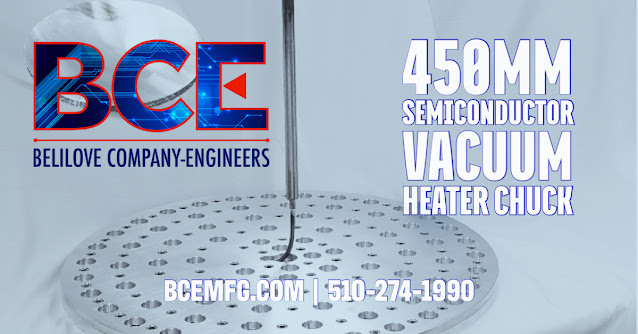
BCE Responds to Chip Shortage with 450mm Vacuum Heater Chuck Design

50mm Vacuum Heater Chuck

BACKGROUND

With the existing chip shortage, an atomic layer deposition (ALD) application up to 360⁰C was the focus of the latest BCE Vacuum Heater Chuck. A compressed assembly was used with many vacuum holes and grooves in the bottom plate to allow the gases to escape during pump down of the vacuum chamber. No surface anodizing was required.

SCOPE

450mm Vacuum Heater Chuck needed to satisfy the following:
  • Temperature <361°C
  • Internal element must be able to withstand temperature <601°C
  • Top surface 16ra
  • A cold section was needed with added thickness for a vacuum fitting
  • 304 Stainless Steel Heat Source
  • 240Volt, 3850Watt (+/-10%)
  • Type “K” Thermocouple was placed near edge (or built-in to heat source)
  • Maximum allowable grooves and holes on the bottom plate to allow any trapped gases to escape

OUTCOME

BCE produced a highly effective vacuum heater which reached an atmospheric temperature of 360°C in under 30 minutes. The reduced mass on the bottom plate provided proper gas elimination with a quicker initial ramp time. Due to this decreased ramp time in atmosphere, a reduced wattage may be an option for the next iteration of the 450mm Vacuum Heater Chuck.


BCE
+1 510-274-1990

850º C Copper Molybdenum (CuMo) Vacuum Heater Chuck

850º C Copper Molybdenum (CuMo) Vacuum Heater Chuck

Vacuum Chuck Heater with Higher Temperature Capability Than Aluminum and Better Uniformity Too!

In a recent test the BCE Copper Molybdenum (CuMo) Vacuum Heater Chuck performed admirably past its stated rating of 850º C up to 900º C during ramp-up and heater stabilization. 

The BCE Copper Molybdenum capability of 850º C clearly outperforms aluminum heater chucks temperature threshold of 450º C by a large margin, and also provides the benefit of more uniform heat distribution. 

For more information contact BCE. Call them at 510-274-1990 or visit this web page.

200mm 8” Copper Molybdenum (CuMo) Vacuum Heater Chuck

Vacuum Heater Chuck

BACKGROUND

Having better uniformity specifications than aluminum with a higher temperature threshold, the Copper Molybdenum (CuMo) Vacuum Heater Chuck displayed stellar performance during ramp-up and heater stabilization. Thermal conductivity (TC) typically 210 to 255 W/m.K (with rolling process) compared to Aluminum at 205 W/m.K. Using a compressed style configuration, we utilized a 304 stainless steel bottom housing since the uniformity requirement was top end specific. This increased heat transfer towards the top CuMo side while reducing customer cost.

200mm 8” Stainless Vacuum Heater Electrical and Performance Specs:

  • High temperature up to 850°C
  • Temperature uniformity 550⁰C (+/-3⁰C)
  • 108 mtorr, pass best config. baseline (~0.4 torr/min)
  • 120 Volt or 208 Volt Up to 750 Watt (+/-10%)
  • External thermocouple optional
  • Surface Finish: As per customer specification
BCE
510-274-1990

150mm 6” Stainless Vacuum Heater Chuck

150mm 6” Stainless Vacuum Heater Chuck

BACKGROUND

An ALD chamber needed to be upgraded to a higher temperature platen, beyond the limits of aluminum.  The application involved reducing the cost of a replacement vacuum heater while keeping the heat transfer and uniformity the same or better in vacuum.  Vacuum integrity was crucial to the success of the project since it needed to comply with the existing vacuum heater chuck being replaced. 

SCOPE

  • 150mm 6” Stainless Vacuum Heater following specs: 
  • Temperature up to 450°C (+/- 1%) 30 minutes or less  
  • 304 SS 2.75 CF Flange Feedthrough with Viton O-ring  
  • 108 mtorr, pass best config. baseline (~0.4 torr/min) 
  • 120 Volt, 950 Watt (+/-10%), 8 Amp 
  • Thermocouple built-in to heater source
  • Surface Finish: 32 Ra 

OUTCOME

  • BCE 6” Vacuum Heater Chuck
  • Medium vacuum compatible
  • Leak-up rate test for the best tool config (~0.4 torr/min).
  • Good temperature uniformity over 6” dia, up-to 450°C.
  • Within ± 2.5°C over most of the wafer, except the edges of a 6” dia.
  • Repeatable and Predictable temperature  ramps up-to 450°C

BCE
510-274-1990